Showing posts with label energy. Show all posts
Showing posts with label energy. Show all posts
Wednesday, June 28, 2017
What I did on my summer vacation -- wind farms!
I just got back from a fun getaway on Block Island RI, which is the home of the U.S.' first offshore wind farm. This windfarm will provide enough clean energy to power 17,000 homes, including all of Block Island (replacing their diesel fuel). People often think that the wind farms are "ugly", but I didn't think they were unsightly, and they certainly look a lot better than washed out cities from fossil-fuel caused sea level rise! Check it out:

Tuesday, May 30, 2017
Those little lightbulbs can make a big difference
You may remember a few years ago when it became impossible to buy incandescent light bulbs in the U.S. Panic spread in some quarters, with folks hoarding the old light bulbs the way my family hoarded classic coke during the new coke debacle.

What does this drop in demand mean for the future? The jury is still out. Some folks predict a bounce back effect -- we'll feel so good about saving energy, we'll just waste it somewhere else. Some folks see an opportunity for utilities to encourage the use of electric vehicles, since we now have unused electrical capacity. Your thoughts?
Thursday, October 8, 2015
From Poop to Power!
Did you know that over 90% of Costa Rica’s power comes from renewable power sources? Or that Denmark makes 50% of its energy at cogen plants? Even iceland produces 25% of its electricity from geothermal sources!
So how has the U.S. started harnessing its local resources? Well the folks in Washington DC are turning lemons into lemonade! Voters from every other part of the nation often accuse folks in Washington DC of being full of …..ahem…..number 2. So now we’re turning it into power! Check out this Washington Post article about how Washington DC is using sludge from its wastewater treatment plant to produce electricity. This news is definitely reason to smile!

(source: barkpost.com)
Tuesday, May 19, 2015
Go Solar!
(photo from solar.sunpower.com)
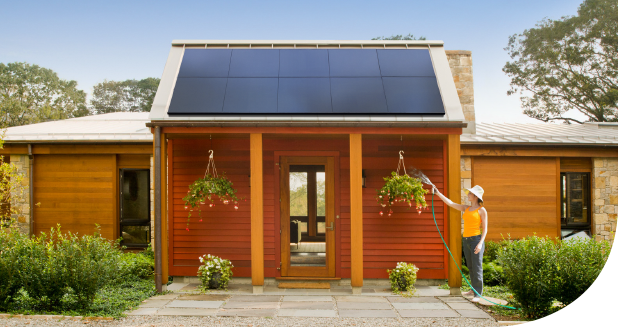
Our town of Vienna VA is currently participating in a program called Solarize Vienna. It’s an innovative program that allows folks to put solar panels on their homes, at a reduced price (due to a group purchase), installed by local companies. The households that participate are also eligible for a federal tax deduction!

Since we’re paying a lot of attention to solar around here these days, we noticed this editorial from the Roanoke Times – lots of interesting information about solar power!
Our view: Some amazing facts
Posted: Sunday, May 17, 2015 2:15 am
The world is full of amazing facts.
Here’s one of them:
There are now more solar energy installers in the country than there are coal miners — 97,000 compared to 80,396.
Whether that’s a good thing or a bad thing depends, in part, on how you feel about coal.
Another amazing fact: Coal production in the U.S. is actually not far from its historic high, which came in 2008 when the nation’s coalfields were made 1.17 billion tons lighter.
Whether you want to blame or credit the decline on coal-mining since then on the Obama administration and its “war on coal” (which, admittedly, is a sexier slogan than “war on carbon emissions”) or the economy or other factors, take your pick.
Still, there’s this: The 97 million tons of coal mined in the U.S. last year means coal production has dropped to levels not seen since . . . 1994. If coal production drops further, then coal under Obama might fall to where it was during, say, the Reagan administration.
If you’re concerned about carbon emissions, this might indeed be “the moment when the rise of the oceans began to slow and our planet began to heal,” as Barack Obama so grandly put it back during his 2008 campaign.
Context: Even though coal production is up 40 percent from where it stood at the end of World War II, the number of miners required to produce that coal is down, way down.
In fact, the number of coal miners in the U.S. peaked in 1920 and has been going down in fits and starts ever since as technology has made the job less labor-intensive. From 725,030 miners then to 80,396 now, according to the Department of Energy. (That’s still a bit higher than the historic low of 71,552 in 2000, but there’s no mistaking the general direction of the trend line.)
In Virginia, the employment commission tells us we now have only about 3,500 coal miners left — or fewer than work in the Roanoke Valley school systems. Or, if you prefer, about double the 1,800 people estimated to be working in the solar energy field in Virginia.
Yet we still refer to the six counties in Virginia’s southwestern tip as “coal counties,” and politicians will spend much time this fall decrying the “war on coal.” True, looking just at miners is a narrow view of the impact of the coal industry. Those figures don’t count, for instance, the railroad workers who haul the black stuff to port. We don’t see trainloads of sunshine rumbling through Roanoke, so that’s one reason why coal has the political impact it does and solar sometimes still gets laughed at.
When Obama recently announced a program to train returning military veterans to work in the solar energy field, the conservative Daily Caller jeered: “This Is How Obama Is Going To Reward Veterans . . . With Solar Industry Jobs.”
Actually, that’s not a bad idea. Solar energy is a growth industry. Forbes says the number of solar jobs has increased by 20 percent two years in a row now. And there’s this: The average wage for installers is said to be $23.63 per hour.
It’s a mystery why many of those who celebrate the joys of blasting the tops off mountains to dig for coal or fracking natural gas out of the ground scoff at solar energy, when it shares essentially the same attribute: It’s domestic energy that no foreign dictator or unstable regime is ever going to cut off.
Critics contend solar is not particularly cheap, propped up only by tax credits — or, if you prefer, tax giveaways. On the other hand, Virginia has given away $573 million in tax credits to coal since 1988, and has only seen the industry decline.
More amazing facts: Germany, not exactly the sunniest spot in the world but certainly one of the most industrialized, produces more solar energy than any other country. At one point last summer, more than 50 percent of its energy was coming from the sun.
What do the Germans know that we don’t? Rather than push big “solar farms,” Germany has encouraged people to install solar panels on their homes. Interestingly, the Erneuerbare Energien Gesetz or German Renewable Energy Act that set up the regulatory framework to make solar energy cheap enough for people to install was championed by a coalition that included both liberals and conservatives — the of kind bipartisanship we don’t see much of in this country.
By contrast, California made headlines this spring when it became the first state to generate more than 5 percent of its energy from solar. Five versus 50? Hmm. Nevada and Arizona are tied at 2.8 percent. But guess who’s fourth and fifth? New Jersey at 1 percent and North Carolina at 0.7 percent.
Virginia’s solar output basically isn’t even on the charts. That’s slowly changing. As part of the bill the General Assembly passed this winter to loosen regulation of the state’s two biggest utilities, Gov. Terry McAuliffe insisted on getting some solar as part of the deal. Dominion Resources was already looking at some solar projects; now it’s committed to investing $700 million to produce 400 megawatts of solar by 2020. That would still put solar at barely a quarter the size of hydroelectric power, which generates about 2.1 percent of the state’s total. So Virginia still wouldn’t rival North Carolina, much less Germany.
Dominion’s first solar farm is slated to start construction in January in Fauquier County. Closer to home, Roanoke, Blacksburg and now Montgomery County have stolen a page from the German energy playbook, using their recent “Solarize Roanoke” and “Solarize Blacksburg” and the ongoing “Solarize Montgomery” campaigns to encourage people to install solar panels on their homes.
The key there: A bulk buying program that reduced the cost. Plus, some tax breaks. Roanoke had offered a property tax abatement for solar projects since 2007 but no one — literally, no one — took advantage of it until the Solarize campaign. Out of that, 18 people signed contracts to install solar systems. In Blacksburg, 59 did. Montgomery’s campaign runs through July 22.
Nell Boyle, sustainability and outreach coordinator for Roanoke, says most of these solar installations are big enough that the users can generate about 20-25 percent of their power from the sun.
A final amazing fact: You know what industry now employs just as many people as coal mines and is soon set to surpass mining if it hasn’t already? The wind industry.
Friday, February 6, 2015
Buffalo Mac!
Be sure to "Like" greenmomster on Facebook for more green news!
 Our furnace died this week, so it’s been a bit nippy at our house lately. This dish is a HUGE hit at our house – providing the heat that we needed! We now have to double the recipe to have enough for everyone. It's adapted from a recipe in Family Circle Magazine. And yes, our new AC is energy star! (photo from sustainablecommunitysolutions.com)
Ingredients
1 lb rotini
1 package Quorn chick'n tenders
1 tsp celery seed
2 tsp smoked paprika
1/2 tsp salt
2 tblsp olive oil
2 celery ribs, sliced
3 tsp jar garlic
4 tblsp butter
3 tblsp all-purpose flour
2 tsp dry mustard
2 1/2 cups skim milk
1/2 cup buffalo wing sauce (I like Wing-Time Medium Buffalo Wing Sauce)
8 oz. sharp cheddar, shredded
3/4 cup crumbled blue cheese
1/2 cup bread crumbs (I like Progresso Italian Style Bread Crumbs)
Instructions
1) Cook pasta to al dente.
2) Defrost chick'n tenders and season with celery seed, 1 tsp paprika, and salt.
3) Heat oil over medium heat in a skillet and brown chick'n tenders. Add celery and saute for about 4 minutes. Add garlic and cook another 2 minutes. Remove chick'n from skillet.
4) In a saucepan, melt 3 tblsp of butter and sprinkle in flour and mustard powder, whisking for 2 minutes. Add milk and buffalo wing sauce, stirring constantly until the mixture boils. Reduce heat and simmer for 3 minutes. Remove from heat and stir in cheddar and remaining tsp of paprika.
5) Add pasta, celery, garlic and chicken to the milk mixture and put in a square 9x9 pan.
6) Heat broiler to 450 degrees. Melt the remaining tblsp of butter and stir in bread crumbs. Sprinkle over dish and broil 2-3 minutes, until browned.
7) Serve with blue cheese as a garnish.
Thursday, May 1, 2014
5 Ways to Get Out of Your Comfort Zone!
As everyone on Facebook knows, it’s “throwback Thursday!” So Greenmomster is joining the trend by re-publishing former posts that still seem relevant. Since we just celebrated Earth Day, here’s an Earth Day post from 2012!
For this Earth Day, I’m not going to suggest tree-planting or trash pickup (see Climate Mama for family friendly ideas). I’m not going to suggest going for a hike or canoe ride. Most of us have a “comfort zone” in which we live. Unfortunately, our comfort zones have led to some pretty uncomfortable realities for the Earth on which we live. This Earth Day, let’s talk about uncomfortable subjects and do something to address the really big “elephants in the room.” Here are 5 suggestions for Earth Day activities that might get us out of our comfort zones.
1) Talk about human population growth and its effect on the planet. Population growth is the “elephant in the room” that no one wants to discuss, but we need to discuss it. There are currently 7 billion people on Earth and many estimates expect a peak of 9 billion people! There are lots of suggestions regarding how we might slow population growth, from increasing women’s educational and economic levels to handing out condoms. What do you think is the most practical solution? What’s the best way to get people to consider the environment when planning family size? On a light note, one group will be giving out endangered species condoms – check them out!
 2) Watch a movie about the coal industry in West Virginia. We should all know where our energy comes from and how our energy use affects the lives of other citizens. To help raise greater public awareness about the environmental and public health impacts of coal,BURNING THE FUTURE: COAL IN AMERICA will air on PBS this April and May. The film will also be available to view free online during Earth Day Weekend (4/21-22/2012). If you’d like to register to watch the film, visit the online registration.
3) Educate yourself about climate change. No matter how much we’d like to stick our heads in the sand, climate change is occurring and it is primarily caused by human activity. Here is some of what we know about climate change from the UN’s Intergovernmental Panel on Climate Change (2007)(IPCC) and the National Oceanic and Atmospheric Administration (NOAA):
- “Global atmospheric concentrations of carbon dioxide, methane and nitrous oxide have increased markedly as a result of human activities since 1750 and now far exceed pre-industrial values determined from ice cores spanning many thousands of years. The global increases in carbon dioxide concentration are due primarily to fossil fuel use and land use change, while those of methane and nitrous oxide are primarily due to agriculture. (IPCC 2007)
- Current levels of atmospheric CO2 are the highest in the past 650,000 years. (NOAA)
- “Average arctic temperatures increased at almost twice the global average rate in the past 100 years. Arctic temperatures have high decadal variability, and a warm period was also observed from 1925 to 1945.” (IPCC 2007)
- “Palaeoclimatic information supports the interpretation that the warmth of the last half century is unusual in at least the previous 1,300 years. The last time the polar regions were significantly warmer than present for an extended period (about 125,000 years ago), reductions in polar ice volume led to 4 to 6 m of sea level rise.” (IPCC 2007). The people in the island nation ofKiribati are planning to move their country in response to current sea level rise.
- “Most of the observed increase in global average temperatures since the mid-20th century is very likely due to the observed increase in anthropogenic greenhouse gas concentrations. This is an advance since the TAR’s conclusion that “most of the observed warming over the last 50 years is likely to have been due to the increase in greenhouse gas concentrations”. Discernible human influences now extend to other aspects of climate, including ocean warming, continental-average temperatures, temperature extremes and wind patterns.” (IPCC 2007)
4) Let your legislators know that climate change is an important issue to you and you really want to see some action on the issue. Climate change is not a Democratic or Republican issue. Legislators on both side of the aisle have stated the need for immediate action. Check out statements and actions from Representative Bob Inglis, Senator Olympia Snowe, Senator Susan Collins, Governor Chris Christie, Representative Chris Smith, President Obama, Representative (resigned) Jay Inslee, and Representative Henry Waxman. Local governments around the country are preparing for the effects of climate change. A May, 2010, article in Scientific American outlined how cities from Berkeley CA to Austin TX to Denver CO are introducing innovative programs to address climate change. In 2009, the 1000th mayor signed the Mayors Climate Protection Agreement, committing to reduce carbon emissions by 7 percent below 1990 levels by 2012. As a group of committed citizens, we must support our elected officials when they act to slow climate change, and strongly encourage them to develop a national energy policy that puts climate change in the forefront.
5) Figure out your personal impact and resolve to make one BIG change. Still not sure what your impact is? Check out www.footprintnetwork.org to see what your personal impact on climate change is. You’ll see that burning fossil fuels, whether to produce electricity in your home, to produce food, or to run your car is a huge contributor to CO2 emissions that affect climate change. Conservation of energy is the biggest way we, as individuals, can slow climate change.
Here’s to leaving our comfort zones and entering a more Earth-friendly future! Happy Earth Day to all!
Be sure to “Like” Greenmomster on Facebook!
Tuesday, February 18, 2014
The children are our future–NOT!
 When it comes to environmental issues, I don’t believe “the children are our future.” We are our children’s future – the decisions we make today determine the environment they’re going to inherit. Thus, if we’re looking for catch-phrases, I think the one from the Great Law of the Iriquois Confederacy makes more sense, “"In our every deliberation, we must consider the impact of our decisions on the next seven generations." So how’re we doing?
The National Environmental Education Foundation(NAEEF) recently released preliminary results of a national survey on environmental attitudes. NAEEF plans to use the results of this survey to guide their work in achieving their goal of having 300 million Americans actively using environmental knowledge to ensure the well-being of the Earth and its people by 2022. Although NAEEF managed to put a positive spin on the preliminary results, I found some of the numbers a bit concerning:
- 77% of adults surveyed turn off a light when leaving a room….
- 54% of adults surveyed look for the energy seal on products….
- 60% of adults surveyed keep up with news about how the environment impacts health…
- 61% of adults visited a park or nature center…
- 23% of adults surveyed don’t turn off lights when leaving a room.
- 46% of adults surveyed don’t look for the energy seal on products.
- 40% of adults surveyed don’t keep up with news about how the environment impacts health.
- 39% of adults surveyed haven’t visited a park or nature center.
- 21% of the adults surveyed were aware that batteries are recyclable, but found it too difficult to recycle them properly.
- 59% of the adults surveyed considered an environmentally conscious lifestyle to be too much work.
- 61% of the adults surveyed consider an environmentally conscious lifestyle too expensive.
Want to keep up on the latest green news? Be sure to "Like" greenmomster on Facebook.
Source:
NAEEF Press Release: New National Survey Findings are Good News for the Environment. Accessed 2/9/2014 at http://www.neefusa.org/assets/files/Benchmark-Survey-launch.pdf
Sunday, February 9, 2014
Climate Change Preach-In

- solar panels and geothermal power in some of the homes in my neighborhood
- new construction in my town building to Energy Star and LEED standards
- more and more folks at mainstream grocery stores (not just Whole Foods or coops) bringing their own bags
- several new mass transit projects, including streetcars and extensions of the metro system
- local groups like Fairfax Climate Watch and the Chesapeake Climate Action Network are providing guidance for folks who would like to become politically active on this issue
So what’s a greenmomster to do? First, educate yourself on the issue of climate change -- there are many great websites and blogs on the topic. Then, take action! The sermon yesterday had lots of great suggestions. If you’d like ideas for simple ways to take action, check out the “Low Hanging Fruit” section of this blog. Climate Mama blog also often has great ideas for action. Finally, become politically active – write your elected officials and tell them this issue really matters to you. You could even attend a rally! Fighting climate change doesn’t have to be all doom and gloom, but, as mentioned in yesterday’s sermon, it will take action and it has to happen now.
Saturday, March 23, 2013
Hugging my neighborhood trees
If you don't want to miss any of the latest news from greenmomster, be sure to "Like" us on facebook.
“Someone’s sitting in the shade today, because someone planted a tree a long time ago.” Warren Buffett
I live in an older neighborhood; many of the original houses were built in the 1950s. As is often the case in older neighborhoods, many folks are buying the older houses, knocking them down, and building newer, bigger homes. No problem – I like new shiny things just as much as the next guy and some of these houses are really beautiful and very energy efficient. Here’s what I don’t like – I don’t like it when builders are allowed to knock down every tree on the property prior to building. Since our neighborhood is older, this process means we’re removing trees that could be 50 years old or older. When we look at the pros and cons of tree removal and planting younger trees, the cons very much outweigh the pros:
Pros for removing old trees and planting younger ones:
Sources:
Farmer, M.C., M.C. Wallace, and M. Shiroya. 2011. “Bird diversity indicates ecological value in urban home prices.” Urban Ecosystems doi: 10.1007/s11252-011-0209-0.
Leung, D.Y.C, and J.K.Y. Tsui, C. Feng, Y. Wing-Kin, L.L.P. Vrijmoed, L. Chun-Ho. 2011. “Effects of Urban Vegetation on Urban Air Quality” Landscape Research, April 2011, vol. 36, issue 2. pp. 173-188.
Little, J.B. 2009. “Where Money Grows on Trees.” American Forests, Spring 2009, vol. 115, issue 1. pp. 43-45.
“Someone’s sitting in the shade today, because someone planted a tree a long time ago.” Warren Buffett
I live in an older neighborhood; many of the original houses were built in the 1950s. As is often the case in older neighborhoods, many folks are buying the older houses, knocking them down, and building newer, bigger homes. No problem – I like new shiny things just as much as the next guy and some of these
 houses are really beautiful and very energy efficient. Here’s what I don’t like – I don’t like it when builders are allowed to knock down every tree on the property prior to building. Since our neighborhood is older, this process means we’re removing trees that could be 50 years old or older. When we look at the pros and cons of tree removal and planting younger trees, the cons very much outweigh the pros:
Pros for removing old trees and planting younger ones:
- Younger trees take up more CO2 as they grow. This pro is countered by the stored carbon released when the older trees are cut down and burned or otherwise disposed of.
- Aesthetically, it’s just not attractive -- Our neighborhood is becoming a patchwork of large houses surrounded by little trees. As my kids would say, it looks like a Lego display built from two different sized kits.
- Soil erosion -- Big, old trees have big root systems. Little trees have little root systems. Big trees hold soil in place better than little trees. Soil runoff is a huge issue in urban and suburban areas, because sedimentation (mud in the water) and phosphorous pollution (phosphorous attaches itself to soil particles) very negatively impact waterways across the country – in my area it greatly impacts the Chesapeake Bay and its tributaries.
- Decreased bird diversity -- As mentioned in a previous post, the presence of rarer birds has been shown to raise housing sale prices. You’ll find more bird diversity in older, mixed stands of trees (Farmer et.al. 2011). Remove the trees, decrease property values.
- Increased energy costs -- Shade trees reduce energy costs (estimated at $25 – $30/per year/per tree) (Little 2009). Remove the trees, pay higher energy bills.
- Decreased local air quality -- Trees help to improve urban air quality by sequestering carbon, reducing urban heat island effects, and even trapping pollutants on their leaves. (Leung et. al. 2011) Remove the trees, deal with decreased urban air quality.
Sources:
Farmer, M.C., M.C. Wallace, and M. Shiroya. 2011. “Bird diversity indicates ecological value in urban home prices.” Urban Ecosystems doi: 10.1007/s11252-011-0209-0.
Leung, D.Y.C, and J.K.Y. Tsui, C. Feng, Y. Wing-Kin, L.L.P. Vrijmoed, L. Chun-Ho. 2011. “Effects of Urban Vegetation on Urban Air Quality” Landscape Research, April 2011, vol. 36, issue 2. pp. 173-188.
Little, J.B. 2009. “Where Money Grows on Trees.” American Forests, Spring 2009, vol. 115, issue 1. pp. 43-45.
Saturday, December 29, 2012
10 Favorite Green Adventures for 2012
‘Tis the season for lists and reminiscing, so greenmomster is going to indulge! Here’s the list of my 10 favorite green activities for 2012. I’d love to hear about yours too – be sure to post them on Facebook!

10) Starting out the New Year at our favorite park – Sky Meadows – with our annual New Years Day hike!
9) Being chosen as a Climate Mama on the Climate Mama website, a website and organization dedicated to reducing human impacts on our climate!
8) Clamming on Block Island RI! What a great day – hanging out with our favorite environmental science teacher, raking up clams, and learning about sustainability.
7) Adopting a stream! OK, maybe our stream wasn’t quite as healthy as we thought, but it was a great experience and we learned a lot. And hope springs eternal – we’re checking out our new stream in January 2013!
6) Goin’ Ape! Swinging from ropes, practicing our tarzan yells, and zip-lining!
5) Volunteering at Sky Meadows State Park with the family! Whether we’re hiking the trails for trail maintenance, designing a calendar, taking pictures at park events, or collecting acorns, any day at Sky Meadows is a great day!
4) Camping at Bear Creek Lake State Park! Canoeing, fishing, archery, s’mores, and glamping in my new BIG tent with the family – what could be better than that?
3) Hiking and biking on Bull Island SC! We’ve still got that SC beach buzz going as we enjoy our sand dollar Christmas tree ornaments.
2) Attending the anti-fracking rally on the U.S. Capitol grounds this summer! Craft supplies for our protest signs – $3; parking near the rally – $20; sunscreen for the incredibly hot day – $10; hearing my son say “Hey Mom, I never knew there were so many people like
1) Definitely one of my favorite green activities every year – watching the baby loggerhead sea turtles dash from their nests to the ocean!
Happy New Year to all of the greenmomsters out there! Here’s to a green 2013!
Monday, October 29, 2012
What on earth is a “code red” day?
Hurricane Sandy's getting ready to hit, but a code red day isn't a day that starts with "red sky in the morning, sailors take warning." And i t’s not a day that starts with a beautiful red sunrise for a balloon launch!
As we’ve discussed in previous posts about asthma, air pollution has significant impacts on our health, as well as on our environment (think climate change). The U.S. EPA, in cooperation with the Sacramento Metropolitan, El Dorado, Feather River, Placer, and Yolo-Solano Air Districts, has developed a great tool for learning about the sources of air pollution in your community and that pollution’s impacts. Smog City 2 lets players set various levels of pollutants and population, as well as weather conditions, in order to see the impacts of various inputs. You can take a close look at particulate pollution and ozone impacts – now you’ll really understand the meaning behind those “code red” days!
After you’ve learned about the impacts of air pollution, check out this energy profiler from U.S. EPA to determine how your local utility provides most of your power.
 t’s not a day that starts with a beautiful red sunrise for a balloon launch!
As we’ve discussed in previous posts about asthma, air pollution has significant impacts on our health, as well as on our environment (think climate change). The U.S. EPA, in cooperation with the Sacramento Metropolitan, El Dorado, Feather River, Placer, and Yolo-Solano Air Districts, has developed a great tool for learning about the sources of air pollution in your community and that pollution’s impacts. Smog City 2 lets players set various levels of pollutants and population, as well as weather conditions, in order to see the impacts of various inputs. You can take a close look at particulate pollution and ozone impacts – now you’ll really understand the meaning behind those “code red” days!
After you’ve learned about the impacts of air pollution, check out this energy profiler from U.S. EPA to determine how your local utility provides most of your power.
Sunday, October 21, 2012
Baby it’s cold outside
OK, maybe it’s not frigid yet, but if you’re a warm-weather-lovin’ greenmomster like me, you’ve already pulled out a few sweaters and blankets and turned on a little heat. As we get ready for winter, here’s a helpful video from the Chesapeake Bay Program on how to de-ice sidewalks when things start to freeze.
And if you’re looking for a little inspirational art, as you weather-strip your doors and windows, check out these great conservation posters (except the coal ones…) from WWII.
And if you’re looking for a little inspirational art, as you weather-strip your doors and windows, check out these great conservation posters (except the coal ones…) from WWII.
Sunday, August 19, 2012
Thankful for weeds
Anyone who’s seen my garden knows I don’t like weeding. I love the flowers. I love the butterflies and bees. I love the vegetables. But I do not like weeding.

So this morning, I put on my old clothes, tied up my frizzy hair (which bugs really dig), spritzed myself with bug repellent, and headed out to do my once-in-a-while chore of weeding. I freed the okra of the tangles of wild strawberry at their feet, and dug up some really stubborn bronze fennel that, although the butterflies like it, was threatening to overtake the raspberries (a pretty good trick, I must say). I took a break to enjoy the hundreds of skippers nectaring on the Joe Pye Weed. Then it was back to pulling the weeds that were choking the yarrow and black-eyed susans.
Despite the fact that I don’t find my happy place when I’m weeding, I’m thankful for the weeds. Although my area of the country has been dryer than usual, we’re not suffering from the severe drought seen in the rest of the country. We’ve had a hot summer, no doubt, but we’ve had rain unlike other parts of the country, which are suffering from relentless drought and heat. According to the National Climatic Data Center (NCDC), 33% of the country is suffering from severe to extreme drought (using the Palmer Drought Index). Reports were released from the NCDC just this week that July 2012 was the hottest month on record in the U.S. Not a lot of weeds growing in much of the U.S., I'm guessing.
Climate scientists for decades have been warning us that this heat and other extreme weather events, including wildfires and storms, will become our new normal if we don’t get serious about climate change. James Hansen, director of the NASA Goddard Institute for Space Studies, wrote a fascinating editorial in the Washington Post last week, explaining how these events are not likely attributable to chance – climate change is occurring and it’s largely a man-made phenomenon. Unfortunately, as scientists have talked and presented paper after paper on the subject, our national leaders and, yes, those of us who vote, have been asleep at the wheel – pulling weeds and cursing their existence, instead of feeling thankful and trying to protect their environment. As our national leaders slowly wake up to this issue (see the congressional members working to keep the windpower tax credit), here are a few actions that the rest of us (who can’t afford solar panels) can take to slow climate change:
- insulate, insulate, insulate – conservation of energy means we won’t have to burn so many fossil fuels
- turn off the lights
- turn up the temperature on your air conditioning
- eat AT LEAST one meat free day per week
- walk more, drive less
- consume less – factories use fossil fuels
As we wait impatiently for our national leaders to develop a reasonable energy policy for the country, let’s do what we can as individuals and try to be thankful for the weeds.
Saturday, July 28, 2012
No Frackin’ Way!


Wednesday, April 18, 2012
5 Ways to Get Out of Your Comfort Zone for Earth Day!

For this Earth Day, I’m not going to suggest tree-planting or trash pickup (see Climate Mama for family friendly ideas). I’m not going to suggest going for a hike or canoe ride. Most of us have a “comfort zone” in which we live. Unfortunately, our comfort zones have led to some pretty uncomfortable realities for the Earth on which we live. This Earth Day, let’s talk about uncomfortable subjects and do something to address the really big “elephants in the room.” Here are 5 suggestions for Earth Day activities that might get us out of our comfort zones.
1) Talk about human population growth and its effect on the planet. Population growth is the “elephant in the room” that no one wants to discuss, but we need to discuss it. There are currently 7 billion people on Earth and many estimates expect a peak of 9 billion people! There are lots of suggestions regarding how we might slow population growth, from increasing women’s educational and economic levels to handing out condoms. What do you think is the most practical solution? What’s the best way to get people to consider the environment when planning family size? On a light note, one group will be giving out endangered species condoms – check them out!
2) Watch a movie about the coal industry in West Virginia. We should all know where our energy comes from and how our energy use affects the lives of other citizens. To help raise greater public awareness about the environmental and public health impacts of coal, BURNING THE FUTURE: COAL IN AMERICA will air on PBS this April and May. The film will also be available to view free online during Earth Day Weekend (4/21-22). If you’d like to register to watch the film, visit the online registration.
3) Educate yourself about climate change. No matter how much we’d like to stick our heads in the sand, climate change is occurring and it is primarily caused by human activity. Here is some of what we know about climate change from the UN’s Intergovernmental Panel on Climate Change (2007) (IPCC) and the National Oceanic and Atmospheric Administration (NOAA):
- “Global atmospheric concentrations of carbon dioxide, methane and nitrous oxide have increased markedly as a result of human activities since 1750 and now far exceed pre-industrial values determined from ice cores spanning many thousands of years. The global increases in carbon dioxide concentration are due primarily to fossil fuel use and land use change, while those of methane and nitrous oxide are primarily due to agriculture. (IPCC 2007)
- Current levels of atmospheric CO2 are the highest in the past 650,000 years. (NOAA)
- “Average arctic temperatures increased at almost twice the global average rate in the past 100 years. Arctic temperatures have high decadal variability, and a warm period was also observed from 1925 to 1945.” (IPCC 2007)
- “Palaeoclimatic information supports the interpretation that the warmth of the last half century is unusual in at least the previous 1,300 years. The last time the polar regions were significantly warmer than present for an extended period (about 125,000 years ago), reductions in polar ice volume led to 4 to 6 m of sea level rise.” (IPCC 2007). The people in the island nation of Kiribati are planning to move their country in response to current sea level rise.
- “Most of the observed increase in global average temperatures since the mid-20th century is very likely due to the observed increase in anthropogenic greenhouse gas concentrations. This is an advance since the TAR’s conclusion that “most of the observed warming over the last 50 years is likely to have been due to the increase in greenhouse gas concentrations”. Discernible human influences now extend to other aspects of climate, including ocean warming, continental-average temperatures, temperature extremes and wind patterns.” (IPCC 2007)
4) Let your legislators know that climate change is an important issue to you and you really want to see some action on the issue. Climate change is not a Democratic or Republican issue. Legislators on both side of the aisle have stated the need for immediate action. Check out statements and actions from Representative Bob Inglis, Senator Olympia Snowe, Senator Susan Collins, Governor Chris Christie, Representative Chris Smith, President Obama, Representative (resigned) Jay Inslee, and Representative Henry Waxman. Local governments around the country are preparing for the effects of climate change. A May, 2010, article in Scientific American outlined how cities from Berkeley CA to Austin TX to Denver CO are introducing innovative programs to address climate change. In 2009, the 1000th mayor signed the Mayors Climate Protection Agreement, committing to reduce carbon emissions by 7 percent below 1990 levels by 2012. As a group of committed citizens, we must support our elected officials when they act to slow climate change, and strongly encourage them to develop a national energy policy that puts climate change in the forefront.
5) Figure out your personal impact and resolve to make one BIG change. Still not sure what your impact is? Check out www.footprintnetwork.org to see what your personal impact on climate change is. You’ll see that burning fossil fuels, whether to produce electricity in your home, to produce food, or to run your car is a huge contributor to CO2 emissions that affect climate change. Conservation of energy is the biggest way we, as individuals, can slow climate change.
Here’s to leaving our comfort zones and entering a more Earth-friendly future! Happy Earth Day to all!
Tuesday, March 6, 2012
The Other CO2 Problem
Last night, I attended a screening of the National Resources Defense Council’s (NRDC) new film, “Acid Test: The Global Challenge of Ocean Acidification.” This 20 minute film is definitely worth the time to watch, and the NRDC has generously allowed free distribution. I hope you’ll take a little time to watch it.
Usually we’re focusing on CO2 as the man-made cause of climate change – we burn various types of fossil fuel (releasing a molecule called CO2 or carbon dioxide) which leads to changes in our atmosphere and an average increase in long-term global temperatures. But, as is shown in this film, there’s another impact of CO2 emissions. When CO2 accumulates in the atmosphere, it often enters the ocean as well. In the ocean, CO2 reacts with water to form carbonic acid. The NRDC states, “Since the start of the Industrial Revolution about 150 years ago, approximately one-quarter to one-third of all CO2 from fossil fuels – or about 500 billion tons – has been absorbed by the seas, increasing the average acidity by 30 percent.”
Now, you may have the same reaction that I did – sure, 500 billion tons is a lot, but the oceans are pretty darn big too. I mean, they can be as deep as 5,000 meters. Fortunately, the local chapter of the Sierra Club, which sponsored the film screening, invited a local oceans expert from George Mason University to answer some questions. He explained that the portion of the ocean that we most commonly encounter is the top 200 meters. That’s where we find most of the sea life on which we depend. That’s where fluctuations in currents impact our climate and weather. So 500 billion tons into the top 200 meters can have a very substantial effect on the health of our oceans.
Ocean acidification affects the many species of animals that build exoskeletons, or external shells or skeletons. These animals need carbonate (another molecule) from which they build these exoskeletons. The availability of carbonate is negatively affected by an increase in ocean acidity (or a drop in pH). If ocean acidity gets high enough, the environment can even become corrosive to the shells of these organisms. The worry is that many of these species could become depleted or even extinct.
But what if you’re not really interested in ocean ecology? Who really gives a flying flit if a few little invertebrates can’t make shells? Well, those little invertebrates are the basis of the ocean food chain. Little animals get eaten by bigger animals, which get eaten by bigger animals. Humans are part of this food chain. The reason to care, if you’re not concerned about species extinction and nature in general, is that your food source could be severely impacted. For great information on worldwide fisheries, check out UN Food and Agriculture, Fisheries and Aquaculture Department.
The NRDC makes some suggestions for greenmomsters who want to do their part in turning around this damage to our oceans:
Any comments on the film?
Usually we’re focusing on CO2 as the man-made cause of climate change – we burn various types of fossil fuel (releasing a molecule called CO2 or carbon dioxide) which leads to changes in our atmosphere and an average increase in long-term global temperatures. But, as is shown in this film, there’s another impact of CO2 emissions. When CO2 accumulates in the atmosphere, it often enters the ocean as well. In the ocean, CO2 reacts with water to form carbonic acid. The NRDC states, “Since the start of the Industrial Revolution about 150 years ago, approximately one-quarter to one-third of all CO2 from fossil fuels – or about 500 billion tons – has been absorbed by the seas, increasing the average acidity by 30 percent.”
Now, you may have the same reaction that I did – sure, 500 billion tons is a lot, but the oceans are pretty darn big too. I mean, they can be as deep as 5,000 meters. Fortunately, the local chapter of the Sierra Club, which sponsored the film screening, invited a local oceans expert from George Mason University to answer some questions. He explained that the portion of the ocean that we most commonly encounter is the top 200 meters. That’s where we find most of the sea life on which we depend. That’s where fluctuations in currents impact our climate and weather. So 500 billion tons into the top 200 meters can have a very substantial effect on the health of our oceans.
Ocean acidification affects the many species of animals that build exoskeletons, or external shells or skeletons. These animals need carbonate (another molecule) from which they build these exoskeletons. The availability of carbonate is negatively affected by an increase in ocean acidity (or a drop in pH). If ocean acidity gets high enough, the environment can even become corrosive to the shells of these organisms. The worry is that many of these species could become depleted or even extinct.
But what if you’re not really interested in ocean ecology? Who really gives a flying flit if a few little invertebrates can’t make shells? Well, those little invertebrates are the basis of the ocean food chain. Little animals get eaten by bigger animals, which get eaten by bigger animals. Humans are part of this food chain. The reason to care, if you’re not concerned about species extinction and nature in general, is that your food source could be severely impacted. For great information on worldwide fisheries, check out UN Food and Agriculture, Fisheries and Aquaculture Department.
The NRDC makes some suggestions for greenmomsters who want to do their part in turning around this damage to our oceans:
- encourage your local, state, and federal government to adopt an energy policy that invests in efficiency and encourages renewable sources based on wind and sun;
- encourage the federal government to establish a strong national policy to protect, maintain, and restore the health of marine ecosystems, end overfishing, and create marine protected areas;
- do your part to reduce use of fossil fuels through conservation at home and on the road.
Friday, January 27, 2012
So you slept through science class, part 2 – molecules, energy, and zebra dung!

In the last post about the basics of science, we talked about DNA. I mentioned that DNA is a molecule, and I outlined its structure and the mutations that can occur in this molecule. Let’s back up a little this week – what exactly is a molecule (for those who always wanted to know, but were afraid to ask)?
 Science talks about something called “matter.” “Matter” is anything that has mass and occupies space. Thus, just about everything you can see and feel is made of “matter.” If we continue to drill down, we find out that matter is made of building blocks called atoms. Just think of atoms as the Legos in this picture, and the castle (matter) is made of atoms. Science textbooks describe atoms as the smallest particle of an element that still retains all of the properties of that element. But what is an “element”? We’ll get back to that in a minute.
When we look at atoms, we see many particles that make up atoms. These particles are called “sub-atomic particles,” and we usually refer to three distinct “sub-atomic particles” -- protons, neutrons, and electrons. Protons and neutrons hang out sort of in the center of the atom (the nucleus), while the electrons fly around the nucleus. The particles are extremely small, with electrons being the smallest. To give some perspective to the relative size of these sub-atomic particles, (this is really cool…) think of the atom as being the size of FedEx Field or any other large stadium. The nucleus, with its protons and neutrons would be roughly the size of a fly sitting on the 50 yard line. The electrons would be about the size of a few gnats flying around the rest of the stadium!
So now we know that protons, neutrons, and electrons make atoms which combine to make matter. But what about elements and molecules?
Each individual atom has a set number of protons in its nucleus (the center of the atoms). An element is a substance consisting of atoms that all have the same number of protons in their nuclei. So for the castle above, if it were made from one element, all the Legos would be the same. Oxygen is an element – every oxygen atom has 8 protons in its nucleus. If the atom had 7 or 9 protons, it wouldn’t be an oxygen atom; it would be the atom of a different element (the element nitrogen for 7 protons in each atom; the element fluorine for 9 protons in each atom). Carbon is an element – every carbon atom has 6 protons in its nucleus.
A molecule is simply the smallest particle of a substance -- any substance like water, DNA, or salt (compare that to an atom, which, as we said, is the smallest particle of an element). At this point (the molecular level) , we’re mixing atoms of various elements to make new substances. We’re no longer just dealing with elements, where every atom is the same. Now we’re mixing various types of atoms to make things like water, DNA, or salt. Molecules can be combinations of different atoms, or several of the same atom.
So, for organization of matter, we’ve got sub-atomic particles (protons, neutrons, electrons) –>atoms –> molecules.
At this point, my students are raising their hands and asking, “will this be on the test?” I need to answer the all-important question – Who gives a flying flit about molecules and matter? What does this have to do with environmental awareness?
Here’s why we care:
 |
| photo by William Widmer |
So there you have it -- molecules in a nutshell. And, yes, nutshells are made of molecules.
Subscribe to:
Posts (Atom)