Showing posts with label citizen science. Show all posts

Tuesday, August 18, 2015

5 fun monarch facts!

We often think that the truly impressive natural wonders are in places like Africa or Yellowstone National Park, but there’s a record-breaking migration happening in your backyard every year around this time.  The monarch butterflies are starting to arrive here on the East coast! 

Yesterday, Vanessa (a park employee) and I headed out to collect monarch caterpillars and eggs – they’ll be raised indoors and then released once they’re adults.  The staff and visitors at Sky Meadows State Park participate in tagging and tracking these fascinating insects on their annual migration to Mexico.

CameraAwesomePhoto (68)

These fascinating insects start as very tiny eggs,

CameraAwesomePhoto (69)

eat their way through several “instars” or molts to become large caterpillars,
monarch caterpillar

and end up as adult monarch butterflies!
monarchrelease4

The Sky Meadows staff participates with Project Monarch Watch to tag and release these butterflies,  This citizen science project helps researchers learn more about monarchs, and it’s a fun project families can do together!

Did you know:
  • monarch butterflies have just one larval host plant (the plant that the caterpillars eat) – milkweed!  That’s why it’s so important to provide lots of milkweed in your gardens.
  • monarch butterflies are distasteful and even toxic to many predators, thanks to the cardiac glycosides found in their larval host plants.
  • monarch butterflies complete a transcontinental migration each year, using 3 to 5 generations of butterflies – read Four Wings and a Prayer by Sue Halpern to learn more about this migration
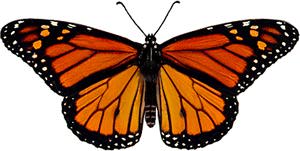
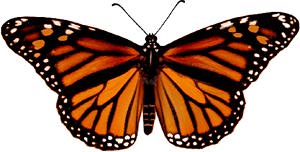
  • it’s easy to tell male and female monarchs apart – just look at their wings.  The males have a pheromone spot (see the broader black line on the bottom or hindwing) (images from Project Monarch Watch)
Male Monarch image
while females don’t
Female Monarch image
  • the monarch butterfly has its own IMAX 3D movie – The Flight of the Butterflies!  This story of the monarch butterfly migration and the scientist who studied it is a fascinating one and appropriate for all ages.
Take a little time out this summer and fall to enjoy this marvel of the natural world that’s right in your own backyard!

Monday, May 11, 2015

Springtime stream monitoring!

We adopted a stream a couple of years ago, so that my family could learn about the effects of urban and suburban development on our local streams.  It’s been an eye-opening experience!  We’ve learned that the runoff from homes, lawns, roads, construction sites, sidewalks, parking lots, etc really does have a negative effect on our local waterways. 

We monitor our stream 4 times per year, and after a long, cold winter, it was time to slip on our boots and head out again!

IMG_0172

Our stream, Difficult Run in Great Falls VA is a beautiful stream and the weather was perfect. 

CameraAwesomePhoto (21)

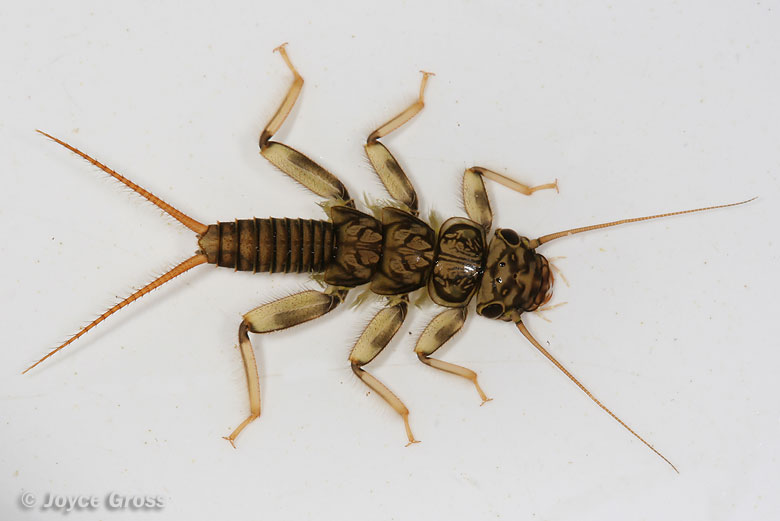
But looks can be a little deceiving.  As usual, the stream wasn’t exactly teaming with critters that thrive on a clean environment – we saw lots of oligochaetes (photo: stroudcenter.org) which are pretty tolerant of sub-par water quality,

and just a few stoneflies (photos: calphotos.berkeley.edu), which prefer nice, clean water.

The roads and development in this suburb near Washington DC definitely have an impact on the streams that feed to the Potomac River and Chesapeake Bay.  It’ll be interesting to see if conditions improve this summer!

Sunday, November 16, 2014

You can help with conservation research!

Do you ever wonder if your volunteering for environmental groups or citizen science projects actually helps with conservation?  Here’s a great example of how citizen data gathering really does make a difference!  A recent study, using data from two decades of Project FeederWatch volunteers, shows a northward shifting of many bird species.  Scientists hypothesize that this shift is due to warming temperatures.

So remember, you can make a difference!  And they’re taking volunteers for Project FeederWatch right now – hint, hint…..

bluebird6

Monday, October 6, 2014

Monarch Migration Time!

Be sure to “Like” greenmomster on Facebook!

It’s time for the monarch butterfly migration toward Mexico!  In past posts, I’ve written about the monarchs, planting a butterfly garden, and even butterfly book reviews.  This time, I thought I’d show you how easy it is to tag monarchs, using tags from Monarch Watch. I spent a recent fall afternoon helping tag monarch butterflies at Sky Meadows State Park in VA.  monarchrelease2It’s easy!  You simply catch the butterfly, attach a tag to the wing area that looks like a tiny mitten (the program provides diagrams), and then release the butterfly!  monarchrelease4This strong little insect will then attempt to fly all the way to Mexico, and you’ve just provided a valuable tool to scientists who are trying to learn about migration patterns and population size.Four Wings and a Prayer: Monarch Butterflies and the Magic of Everyday Life

Want to learn more about the monarchs and their migration?  Be sure to check out Four Wings and a Prayer by Sue Halpern. 

Thursday, August 7, 2014

TBT–Latest Buzz on Counting Bees

bee on liatrisIf you’re noticing lots of bumblebees in your garden, but don’t know which species they are, this is the TBT for you!  Join the Xerces Society and count those bees!

If you’re anything like me, you enjoy the buzz in your garden when the weather warms up and the bumblebees are all over the lavender and joe-pye weed in your garden.  The fall and winter just feel cold and lonely in the garden without that familiar buzz.  Well chins up, greenmomsters!  There’s a project that you can look forward to in 2014!  Join the Xerces Society in their citizen science project – Bumblebee Watch!  As things warm up next spring, you’ll be able to help scientists determine the number of species and the number of individual bees in North America!  You can get all the info and sign up at the Xerces Society website.

Want to keep up on other citizen science projects and green news?  Be sure to “Like” greenmomster on Facebook!

Friday, May 23, 2014

Turtles Rock!

Want to keep up on all the latest green news?  Be sure to "Like" greenmomster on Facebook!

In honor of World Turtle Day, I’m re-posting about my favorite animals – the loggerheads at Edisto Island SC!  Meat-free Friday resumes next week!


As I’ve mentioned in previous posts, one of the high points of my summer each year is visiting the beaches of South Carolina and watching the baby loggerhead turtles head for life in the ocean.  This year was no different!  It’s been a great year for loggerheads in SC; both Bull Island and the Edisto Beach State Park reported their second highest number of nests (last year was number 1).  One of the naturalists speculated that since the turtle protection project is in its 30th year, and it takes roughly 30 years for loggerhead turtles to reach sexual maturity, the program is just now beginning to show the product of all the hard work.  Turtle project managers hope that this is just the beginning of many more successful nesting years for these endangered turtles.
Loggerhead turtles are truly impressive creatures.  They start off small, but grow to a whopping 200-300 lbs!  IMG_20130815_190125_501  Following a harrowing run to the ocean, avoiding hungry seagulls, the baby turtles hitch a ride on an ocean current and make their way to the Sargasso Sea.  There they float in the sargassum until they grow large enough to continue their 30 year journey north through the Atlantic Ocean and then down to the Caribbean.  Only about 1 in 1000 eggs laid reaches sexual maturity!
Here’s a myth-buster!  Have you heard that sea turtles always return to the same beach to nest?  Well, recent DNA research is showing that this isn’t always the case.  One female turtle this year laid eggs in three states!
So what is this turtle protection program I keep mentioning?  Many naturalists, turtle researchers, and volunteers deserve credit for this successful program.  Tiny turtles hatch from the soft eggs IMG_20130815_184203_296, which the females lay in deep holes above the high tide line in the middle of the night.  Early each morning, researchers and volunteers head to the beach to mark the location of new nests and protect the nests with flags and fencing.  If staff believe that the nests are below the high tide line, they may decide to move the nest further toward the dunes to avoid flooding of the nest.  After the expected date of nest hatching, staff again spring into action.   This volunteer is digging up a nest which has already hatched, to see if there are any hatchlings alive but trapped in the nest (they didn’t make it out with the rest of the baby turtles).   IMG_20130815_184059_922  After digging up the hatched nests, volunteers and program staff log the number of eggs hatched and the number of unhatched eggs:  IMG_20130815_184641_381.  The nest in the previous picture had many unhatched eggs; staff hypothesized that the nest was laid below the high tide line.  After the volunteers find any turtles still trapped in the nest, they set the tiny creatures free to begin their ocean adventure.  turtle hatchling at sunset
Sea turtles have been on Earth for millions of years and are currently threatened by human activities including entrapment in fishing gear, boat strikes, and pollution which turtles can mistake for food.  You can help these incredible creatures and the programs designed to protect them:

  • Never litter on the beach.  Pick up any litter you see (cups, plastic bags, bottles) to protect turtles from accidental ingestion
  • Only buy shrimp from fleets that use Turtle Excluder Devices (TEDs) on their fishing gear (it’s a law for U.S. fleets)
  • You can adopt a turtle or adopt a nest – what a great way to help protect these magnificent creatures!

Sunday, February 23, 2014

The Winter River Dance

About a week ago, we had over a foot of snow; then it warmed up and rained.  The temperatures were supposed to hit 60 degrees this weekend, so you can bet our family took advantage of the nice weather to survey our stream – Difficult Run in Great Falls VA.  The water was relatively (but not dangerously) high and running pretty quickly.  It definitely looked muddy, too, so we weren’t really sure what we would find.  We did our “river dance” four times for 60 seconds each.  We danced near the riffles (places where the water is not still and the invertebrates get lots of oxygen).  We danced deep20140222113832 and we danced shallow 20140222120046Unfortunately, all that dancing yielded lots of algae20140222114030 and only 29 invertebrates – we should have seen at least 200!  Our stream earned a score of 8, which means the health of the stream is a bit uncertain at this point -- at least it's not a 4 or 5, like some stretches of the stream we surveyed have been!  The good news is, we saw some creatures that generally like pretty clean water – caddisflies and stoneflies.  Despite dancing into the stream bed nearly 1 foot, we couldn’t find any of the many clams we found last count.  We’re looking forward to counting in warmer weather – who knows what spring will bring!

Remember that you too can “adopt” a stream and monitor for invertebrates.  If you live in Fairfax County VA, contact the Northern VA Soil and Water Conservation District.   Somewhere else in VA?  Contact Virginia Save Our Streams (VASOS).  Not in VA?  Check out the information from the Izaak Walton League of America.  It’s fun and you’ll learn a lot about the health of your local streams!
bugs bumber sticker
Want to keep up on all the latest green news AND meat-free recipes?  Be sure to “Like” greenmomster on Facebook!

Monday, December 16, 2013

The latest buzz on counting bees

bee on liatrisIf you’re anything like me, you enjoy the buzz in your garden when the weather warms up and the bumblebees are all over the lavender and joe-pye weed in your garden.  The fall and winter just feel cold and lonely in the garden without that familiar buzz.  Well chins up, greenmomsters!  There’s a project that you can look forward to in 2014!  Join the Xerces Society in their citizen science project – Bumblebee Watch!  As things warm up next spring, you’ll be able to help scientists determine the number of species and the number of individual bees in North America!  You can get all the info and sign up at the Xerces Society website.

Want to keep up on other citizen science projects and green news?  Be sure to “Like” greenmomster on Facebook!

Sunday, November 17, 2013

So you slept through science class, part 8–How do ecologists get those numbers?

Like getting all the latest green news?  Be sure to "Like" greenmomster on Facebook!

Here in greenmomster’s science class, we’ve covered many topics including endangered species, wildlife corridors, and biodiversity, but you may be wondering, “how do environmental managers come up with the numbers on which their decisions are based?”  It turns out, there are many ways to calculate the size or activity of a population of organisms:
  • If the organisms are relatively still, like oysters or dandelions, scientists will often use a “quadrat” or a sample area like a circle or square to estimate the number of individuals in a larger area.  First, you lay down the quadrat.  Next, you count the number of individuals in the quadrat.  Repeat this procedure several times, and then do the calculation to get your estimate for a larger area.
  • If the organisms have a tendency to move, sometimes scientists will conduct “mark-recapture” surveys.  Let’s say they want to know how many box turtles are in an area.  First the scientists set out traps to catch the box turtles.  Then they mark the turtles they caught and set them free.  When the scientist later catches more turtles, he or she checks to see whether the turtles are marked.  That info (number of marked vs. number of unmarked) goes into a calculation to determine the population size.
  • Another way to count individuals and determine any change over time is to walk a line or transect through an area over the course of a week, month, year, or longer.  As the scientist walks along, he or she counts each individual of a species that is seen within a set distance (maybe 15 feet).   Repeating this procedure over a long time can possibly tell a scientist if a change in population size is occurring over time or between different locations.  I used this method when studying butterflies in butterfly gardens.  My butterfly watching volunteers and I walked transects through over 100 gardens, once per week, for six months during each of two years – it gave us a great idea of which butterfly gardens attracted the most butterflies and which types of butterflies they attracted.
There are so many ways to calculate population sizes!  What about when the individuals aren’t very visible, like underwater animals?  There’s some fascinating work that’s been done on whales to determine where they go and what they do when they’re underwater – check out this video from Science Friday.
And what’s a scientist to do, if there aren’t any formally gathered data to be found?  A recent study reported on in the the Fall 2013 issue of dukenvironment magazine showed that even antique menus can be helpful clues in determining historic fish stocks.  The researchers took a look at the types of fish that were found on menus from restaurants in Hawaii in the early and mid-1900s:  “The team’s analysis of 376 menus from 154 different restaurants showed that near-shore species such as reef fish, jacks and bottom fish, for example were common on Hawaiian menus before 1940, but by its statehood in 1959, they appeared collectively on less than 10 percent of menus sampled.  Restaurants began shifting to serving large pelagic species, such as tuna and swordfish.  By 1970, 95 percent of the menus contained large pelagics; inshore fish had all but disappeared.”  The team then went on to try to come up with reasons for the shift – population? taste? technology?  So creative!
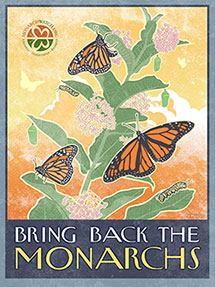
Bring Back The MonarchsCould you be part of a scientific study?  You bet!  Many scientific studies that gather information on populations use “citizens scientists”.  If you’re interested in getting involved, check out these interesting programs:
  • Monarch Watch allows you to help count monarchs and track their North American migration
  • Project Feeder Watch allows you to help count birds that visit your backyard feeders during the winter
  • The Xerces Society has several opportunities for you to help monitor populations of dragonflies
  • You can help the USGS monitor frogs in your area
Now that you know the basics, you’re ready to help!  Not only do scientists have to be technically strong to solve today’s environmental challenges, they also have to be creative, and who’s more creative than a greenmomster?
Sources:
“Seafood Menus reflect long-term ocean changes.”  Fall 2013.  dukenvironment. p 12.

Sunday, September 1, 2013

Turtles Rock!

Want to keep up on all the latest green news?  Be sure to "Like" greenmomster on Facebook!

As I’ve mentioned in previous posts, one of the high points of my summer each year is visiting the beaches of South Carolina and watching the baby loggerhead turtles head for life in the ocean.  This year was no different!  It’s been a great year for loggerheads in SC; both Bull Island and the Edisto Beach State Park reported their second highest number of nests (last year was number 1).  One of the naturalists speculated that since the turtle protection project is in its 30th year, and it takes roughly 30 years for loggerhead turtles to reach sexual maturity, the program is just now beginning to show the product of all the hard work.  Turtle project managers hope that this is just the beginning of many more successful nesting years for these endangered turtles.

Loggerhead turtles are truly impressive creatures.  They start off small, but grow to a whopping 200-300 lbs!  IMG_20130815_190125_501  Following a harrowing run to the ocean, avoiding hungry seagulls, the baby turtles hitch a ride on an ocean current and make their way to the Sargasso Sea.  There they float in the sargassum until they grow large enough to continue their 30 year journey north through the Atlantic Ocean and then down to the Caribbean.  Only about 1 in 1000 eggs laid reaches sexual maturity!

Here’s a myth-buster!  Have you heard that sea turtles always return to the same beach to nest?  Well, recent DNA research is showing that this isn’t always the case.  One female turtle this year laid eggs in three states!

So what is this turtle protection program I keep mentioning?  Many naturalists, turtle researchers, and volunteers deserve credit for this successful program.  Tiny turtles hatch from the soft eggs IMG_20130815_184203_296, which the females lay in deep holes above the high tide line in the middle of the night.  Early each morning, researchers and volunteers head to the beach to mark the location of new nests and protect the nests with flags and fencing.  If staff believe that the nests are below the high tide line, they may decide to move the nest further toward the dunes to avoid flooding of the nest.  After the expected date of nest hatching, staff again spring into action.   This volunteer is digging up a nest which has already hatched, to see if there are any hatchlings alive but trapped in the nest (they didn’t make it out with the rest of the baby turtles).   IMG_20130815_184059_922  After digging up the hatched nests, volunteers and program staff log the number of eggs hatched and the number of unhatched eggs:  IMG_20130815_184641_381.  The nest in the previous picture had many unhatched eggs; staff hypothesized that the nest was laid below the high tide line.  After the volunteers find any turtles still trapped in the nest, they set the tiny creatures free to begin their ocean adventure.  turtle hatchling at sunset
Sea turtles have been on Earth for millions of years and are currently threatened by human activities including entrapment in fishing gear, boat strikes, and pollution which turtles can mistake for food.  You can help these incredible creatures and the programs designed to protect them:
  • Never litter on the beach.  Pick up any litter you see (cups, plastic bags, bottles) to protect turtles from accidental ingestion
  • Only buy shrimp from fleets that use Turtle Excluder Devices (TEDs) on their fishing gear (it’s a law for U.S. fleets)
  • You can adopt a turtle or adopt a nest – what a great way to help protect these magnificent creatures!

Tuesday, March 27, 2012

You put your whole self in!

I went to a terrific event at my son’s school last Friday night that reminded me of this line from the “Hokey Pokey.”  The event was called “Make the Cut,” and it was an event for people to donate hair to make wigs for cancer patients.  Over 50 boys and girls at Thoreau Middle School donated 8 inches of hair in honor of one of their classmates who is currently battling cancer.  What a great group of kids, willing not just to raise money, but to literally give a piece of themselves to help others! 

Watching these inspirational students got me thinking about volunteering in general, and volunteering for the environment in particular.  Although contributing money or participating in a walk-a-thon are great ways of supporting your favorite charity, giving ofmonarch caterpillar your time and talents is often even more challenging and more rewarding.  One of the ways we can actually “put our whole selves in” to volunteering for the environment is through citizen science.  Never heard of it?  Well, it’s a way for members of the public to participate in environmental scientific research.  I know folks who have participated in scuba diving to help with oyster research in the Chesapeake Bay, folks who have counted nesting loggerhead turtles in the middle of the night, folks who have climbed into chilly creeks to help with amphibian research in the Shenandoah mountains, and folks who watch pandas at the National Zoo for hours on end, logging each of the panda’s movements for researchers to later analyze.  When I was working on my dissertation on butterfly gardens, I used nearly 100 “citizen scientists” to help me with my research.  My volunteers counted butterflies each week from May to October during the hottest part of the day and submitted their results so that we could learn more about the usefulness of these habitat islands. 

Citizen scientists participate in bio-blitz activities in the Potomac Gorge and other spots nationwide.  They help count winter birds through Project Feeder Watch and tag monarch butterflies with Monarch Watch.  They help survey fireflies in their yards during the summer, and survey for eagles in the winter in New Jersey.  The Sierra Club even offers opportunities for service trips for citizen scientists and volunteers!DSC_0025  Want to know more?  Listen to the most recent program on the Animal House about citizen science.

Citizen science is a great way to get a little bit more involved in environmental science and volunteering.  It usually requires no special training (they’ll train you), but if you have a specific expertise that’s nothing but an extra plus!  And just like the kids who “put their whole selves in,” the rewards of this type of volunteering are exciting and memorable!

Saturday, March 10, 2012

Saturday Stream Monitoring

It was a chilly Saturday morning, with temperatures in the 30s, and the first Saturday in a very long time without an early morning hockey game or two.  Was it the perfect morning for a sweet greenmomster to let the family sleep in and surprise them with a breakfast of whole wheat waffles covered in fresh fruit and organic whip cream?  Au contraire!  I woke the family up, told them to put on their jackets, and get ready to wade in ice-cold water – we were going stream monitoring!

To the quiet hum of children moaning and complaining, we drove off to help out with the search for benthic macroinvertebrates (large bugs and other animals without backbones that live on the stream bottom) in one of our local streams.  I chose a stream that I knew was in our local watershed.  A watershed is an area in which all water (rain, snowmelt, etc.) runs into the same stream or river.  Any water that people in my neighborhood use to water plants, rinse off the driveway, or wash a car can eventually end up in this particular stream (see Friends of Accotink Creek).

In order to survey the stream, you need people to hold the net and people to “dance,” or stir up the stream bottom to catch any invertebrates that come swimming away.   Then, the group takes a look in the net and counts all of the various critters.  High biodiversity, or variety in the types of animals we see, is one indicator of a healthy stream.  The good news is that the kids actually enjoyed themselves (heh, heh, I knew they would!) and learned a little something about their local environment.  The bad news is the lack of biodiversity in the stream.  How can we help get our streams healthier?  Decrease use of pesticides and fertilizers, plant native plants because they need fewer chemicals than non-natives, and fix any oil or antifreeze leaks in your car.

Activities like this one are happening throughout the country – a quick search of your local area will turn up the schedule of activities that anyone can join.  These activities are great for a number of reasons.  First, kids really see the fun side of science.  Instead of sitting in a classroom, listening to the teacher or reading a textbook (both of which are important activities), kids are out in the stream, churning up water, and counting critters.  They get to see the scientific process at work.  Second, we all begin to see our role in protecting our local environment.  An interesting study in PLoS ONE by Ballouard, et al (2011) showed that the internet seems to be making our children aware of charismatic, exotic animals (like tigers), at the expense of knowledge about local species.  Kids and adults are starting to lose touch with their local environments and their role in protection of that environment.  I see this phenomenon all the time in my classroom; students can tell me about animals in the rainforest, but they can’t tell me 5 bird species we might find outside the classroom window.  The third reason this is a great activity is that we’re contributing to “citizen science.” More and more, everyday citizens, as opposed to professional scientists, are making valuable contributions to data collection.  I used citizen scientists in my dissertation research.  Without my more than 50 volunteers, there’s no way I could have surveyed over 100 butterfly gardens each week for 2 years!

You can sleep late some other day!  Get out and enjoy the environment in your own backyard!

Click on photo to see "stream dance" video