Wednesday, November 27, 2013

Adoption is a great option!

DSC_0072When my husband and I first came home with our daughter, whom we adopted from South Korea, many folks asked us, “Why did you adopt, when you’re able to have your own biological children?”  The first answer was, because our daughter was waiting for us in Korea!  But the more concrete answer was that while we wanted a slightly larger family, for environmental reasons we only wanted to have 2 biological children.  Most people looked at us like we were crazy, or told us they’d never thought about that issue when planning family size. 

When it comes to environmental issues, human population growth is often the “elephant in the room.”  We know it’s an issue, but we don’t talk about it * for fear that the conversation will careen into a ditch of immigration and abortion arguments.  Here’s the bottom line:  There are currently over 7 billion people on Earth and U.N. demographers estimate that, best case scenario, population will continue to grow until it has reached approximately 9 billion.  Each year, the roads seem a little more crowded, housing gets a little tighter, and water becomes a more limited resource. Although the U.S. birth rate is not as high as that of some other countries, we’re all citizens of Spaceship Earth (see? I went all 70s on you).  Every person born is a blessing, but he or she is also another person needing access to the Earth’s natural resources – clean water, space to live, food to eat.  No one that I know thinks it’s a good idea for governments or religious institutions to mandate family size.  That’s why we need to be willing to talk about the topic so that people can make their own informed decisions.  When planning the size of one’s family, one consideration should be future generations.  The more children we put on the Earth now, the more our great grandchildren will have to share a limited pool of resources.

Many of us have grown up in big families and dream of having a big family of our own – OK.  That’s why adoption shouldn’t just be an option for couples who can’t conceive their own biological children; it should be an option that anyone wanting a family should consider.  We should encourage open and honest dialog about family size and encourage the discussion of adoption as a great option for building a family (particularly a larger family).  Adoption is certainly not an option for everyone – some folks are simply not comfortable with the idea.  But I think many more people, including people who can have their own biological children, could be comfortable with adoption and should be encouraged to consider this option.

November is National Adoption Month and November 23 was National Adoption Day; both events are designed to increase awareness of adoption and this year the focus is on the thousands of children in foster care waiting to find permanent homes. Adoption is great for kids waiting on a permanent home, great for the families who would be welcoming a wonderful new family member, and great for a sustainable future.

* Current conversation in Conservation Biology, regarding consumption and population, excepted:

Allendorf, T.D. and K. Allendorf.  2012.  What every conservation biologist should know about human population.  Conservation Biology 26:  953-955.

Hurlburt, S.  2013.  Critical need for modification of U.S. population policy.  Conservation Biology 27:  887-889.

Tuesday, November 26, 2013

ESA under attack

turtle hatchling at sunsetAs we celebrate 40 years of the U.S. Endangered Species Act, Senators Paul, Heller, and Lee have introduced Senate Bill 1731.  This bill proposes delisting all listed species after 5 years, regardless of whether they’ve been recovered, and moves management of endangered species to the states (which we all know is a great idea, since animals and plants always stay within the border of one particular state -- check out the fragmentation post, if you don’t know why this statement is untrue).  Hopefully, this bill will die quietly in committee, but you might want to sign up to track its progress at govtrack.us.  Remember, legislators need to hear from all the greenmomsters out there!

Sunday, November 24, 2013

It just ain’t as much fun as twerking -- 5 pieces of climate change news that you might have missed

edisto eveningBe sure to "Like" greenmomster on Facebook!

While our local news outlets have been busy providing us with important news (ie.  the definition of twerking, which stores will open on Thanksgiving for Black Friday, and why Toronto’s mayor thinks he should stay in office), there have actually been some important news stories on the topic of climate change (an issue that will affect every one of the 7 billion people on Earth).  Here are a few articles/posts/reports from the past several months that you might want to check out:
  1. The UNEP and World Meteorological Organization’s Intergovernmental Panel on Climate Change issued its 2013 report.  From the Summary for Policy Makers, “Warming of the climate system is unequivocal, and since the 1950s, many of the observed changes are unprecedented over decades to millennia. The atmosphere and ocean have warmed, the amounts of snow and ice have diminished, sea level has risen, and the concentrations of greenhouse gases have increased.”
  2. A paper published in the journal Nature in October predicted when we might see higher temps as the “norm” in areas around the world.  This paper from researchers at the University of Hawaii sheds new light on the urgency of needed changes in human contributions to climate change.  (Mora, C., et al.  2013.  “The projected timing of climate departure from recent variability”  Nature 502, 183-187.)
  3. The Warsaw Climate Change Conference was held in November.  Check this site for updates.
  4. The coal industry staged a protest against EPA’s new rules to control carbon emissions. It’s good to be acquainted with both sides of the argument!
  5. Energy Star has begun its Do 1 Thing campaign with tips on what you can do in your home to reduce energy waste (and, thus, climate change).  Topics covered so far include lighting and simple insulation tips.
As we all know well, our Federal government representatives are a bit too busy at this time to deal with issues like climate change.  Climate change is definitely an area in which we must “Think Globally. Act Locally.”  What’s going on in your neighborhood?  Any new building projects that need a greenmomster to ask about energy efficiency?  I know in my town of Vienna VA, they’re designing a vision for our main street – fortunately they’re considering environmental issues and listening to town residents, but attendance by greenmomsters at town meetings is essential!  What about your local energy provider?  Up and down the east coast of the U.S., wind energy is on the verge of success – why not encourage your energy provider and local officials to support this option?
Nope, climate change might not be quite as entertaining as Mileys’ latest antics, but I’m guessing your grandchildren will be glad you paid attention to the less glamorous stuff.


Friday, November 22, 2013

Perfect Pozole!

IMG_20131111_162952_993Don't forget to "Like" greenmomster on Facebook for all of the meat-free Friday recipes!

Here’s a way to have your pozole in vegetarian form.  It’s super-tasty, so you may want to double the recipe!  This recipe is adapted from one from Michael Lomonaco on the Today Show.

Ingredients
2 packages Quorn chik’n tenders, defrosted
1/4 cup olive oil
2 onions, chopped
2 red bell peppers, chopped
2 tblsp ground cumin
2 tblsp garlic
2 small cans Hatch green chiles
1 can Rotel (tomatoes and chiles)
2 quarts veggie broth (add more if you need more liquid)
1 28 ounce can hominy
sour cream

Instructions
  1. Heat oil in a large pot.  Add chik’n with salt and pepper to taste; cook until very slightly browned.
  2. Add onions and red pepper and cook until onions are soft.
  3. Add cumin, garlic, chiles, and Rotel – mix well.
  4. Pour in veggie broth and allow the mixture to boil.
  5. Lower heat, add hominy, and warm through.
  6. Serve topped with sour cream, if desired.  Enjoy!

Wednesday, November 20, 2013

All the Ho! Ho! Ho! and none of the guilt

20131120112544Like getting all the latest green news?  Be sure to "Like" greenmomster on Facebook!
I come from a family of Christmas card-senders.  We love to send and receive personalized Christmas cards with a photo and a letter.  The E-card just doesn’t cut it for us.  Fortunately, I’ve discovered a great place to order personalized Christmas cards on 100% recycled paper – yay!  This year I ordered my cards from Minted, a company that uses designs from artists all around the country, and for a little extra, you can have your cards printed on recycled paper.  I ordered my cards last week, received a proof for my approval within a day, and then received my cards BEFORE the estimated date.  And the cards are BEAUTIFUL!  So feel free to send out those Christmas greetings guilt-free!

Greenmomster’s official disclaimer:  I received zip, zilch, and nada for this endorsement – just liked the product and thought you might want to check it out.

Sunday, November 17, 2013

So you slept through science class, part 8–How do ecologists get those numbers?

Like getting all the latest green news?  Be sure to "Like" greenmomster on Facebook!

Here in greenmomster’s science class, we’ve covered many topics including endangered species, wildlife corridors, and biodiversity, but you may be wondering, “how do environmental managers come up with the numbers on which their decisions are based?”  It turns out, there are many ways to calculate the size or activity of a population of organisms:
  • If the organisms are relatively still, like oysters or dandelions, scientists will often use a “quadrat” or a sample area like a circle or square to estimate the number of individuals in a larger area.  First, you lay down the quadrat.  Next, you count the number of individuals in the quadrat.  Repeat this procedure several times, and then do the calculation to get your estimate for a larger area.
  • If the organisms have a tendency to move, sometimes scientists will conduct “mark-recapture” surveys.  Let’s say they want to know how many box turtles are in an area.  First the scientists set out traps to catch the box turtles.  Then they mark the turtles they caught and set them free.  When the scientist later catches more turtles, he or she checks to see whether the turtles are marked.  That info (number of marked vs. number of unmarked) goes into a calculation to determine the population size.
  • Another way to count individuals and determine any change over time is to walk a line or transect through an area over the course of a week, month, year, or longer.  As the scientist walks along, he or she counts each individual of a species that is seen within a set distance (maybe 15 feet).   Repeating this procedure over a long time can possibly tell a scientist if a change in population size is occurring over time or between different locations.  I used this method when studying butterflies in butterfly gardens.  My butterfly watching volunteers and I walked transects through over 100 gardens, once per week, for six months during each of two years – it gave us a great idea of which butterfly gardens attracted the most butterflies and which types of butterflies they attracted.
There are so many ways to calculate population sizes!  What about when the individuals aren’t very visible, like underwater animals?  There’s some fascinating work that’s been done on whales to determine where they go and what they do when they’re underwater – check out this video from Science Friday.
And what’s a scientist to do, if there aren’t any formally gathered data to be found?  A recent study reported on in the the Fall 2013 issue of dukenvironment magazine showed that even antique menus can be helpful clues in determining historic fish stocks.  The researchers took a look at the types of fish that were found on menus from restaurants in Hawaii in the early and mid-1900s:  “The team’s analysis of 376 menus from 154 different restaurants showed that near-shore species such as reef fish, jacks and bottom fish, for example were common on Hawaiian menus before 1940, but by its statehood in 1959, they appeared collectively on less than 10 percent of menus sampled.  Restaurants began shifting to serving large pelagic species, such as tuna and swordfish.  By 1970, 95 percent of the menus contained large pelagics; inshore fish had all but disappeared.”  The team then went on to try to come up with reasons for the shift – population? taste? technology?  So creative!
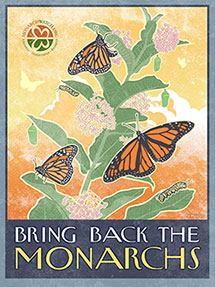
Bring Back The MonarchsCould you be part of a scientific study?  You bet!  Many scientific studies that gather information on populations use “citizens scientists”.  If you’re interested in getting involved, check out these interesting programs:
  • Monarch Watch allows you to help count monarchs and track their North American migration
  • Project Feeder Watch allows you to help count birds that visit your backyard feeders during the winter
  • The Xerces Society has several opportunities for you to help monitor populations of dragonflies
  • You can help the USGS monitor frogs in your area
Now that you know the basics, you’re ready to help!  Not only do scientists have to be technically strong to solve today’s environmental challenges, they also have to be creative, and who’s more creative than a greenmomster?
Sources:
“Seafood Menus reflect long-term ocean changes.”  Fall 2013.  dukenvironment. p 12.

Friday, November 15, 2013

Spaghetti with olives

Like getting your Meat-Free Friday recipes and all the latest green news?  Be sure to “Like” Greenmomster on Facebook!
IMG_20131109_180658_721This tangy pasta recipe is always a big hit at our house.  I adapted the recipe from one found in the November 2012 issue of Cooking Light.  Serve with salad and some King’s Hawaiian Rolls and you’ve got a great Friday night meal!

Ingredients
8 ounces spaghetti, cooked al dente
2 tblsp olive oil
2 small onions, chopped
2 tsp minced garlic
1 tsp dried oregano
1/2 tsp celery salt
1/4 tsp black pepper
1/4 tsp crushed saffron
1 package fake ground beef (I like Morningstar Farms or Lightlife)
2 cups red pasta sauce (homemade or prepared)
1/2 cup pepper-stuffed olives
1 tblsp capers

Instructions
  1. Heat oil in a large pot.  Add onions and saute until almost clear.  Add garlic and saute about 1 minute.  Add oregano, celery salt, pepper and saffron.
  2. Add fake beef and cook thoroughly.
  3. Stir in red sauce, olives, and capers.  Bring to a boil.
  4. Pour over warm pasta and enjoy!