Showing posts with label gorilla. Show all posts
Showing posts with label gorilla. Show all posts
Monday, April 23, 2018
Moke makes our day on Mammal Monday!

Tuesday, March 26, 2013
Is this how we treat family?
In past posts, we’ve discussed illegal trafficking of various endangered species, including the illegal trade in elephant parts, reptiles (in book list), pangolins, and butterflies (in book list). This week, I wanted to call your attention to a recent UN report on our closest cousins, “Stolen Apes: The Illicit Trade in Chimpanzees, Gorillas, Bonobos and Orangutans,” (here’s a link to the pdf) produced by the UN Environment Programme (UNEP) through the Great Apes Survival Partnership (GRASP). This report estimates that over 22,000 great apes have been lost from the wild since 2005, and that 64% of those animals were chimpanzees. Unlike our usual culprits when it comes to threats to endangered species, we’re not looking at habitat loss, deforestation, mining, hunting for bushmeat, or pollution. The enemy now seems to be a very well-organized network of illegal trafficking in live animals or animal parts, yet only 27 arrests were made in Asia and Africa from 2005 to 2011, and only 1/4 of those arrests were prosecuted. Recommendations from the report include:
- increasing protection of habitat areas
- increased training for police officers and customs agents, as well as trans-national criminal intelligence units
- use of national and international multi-media campaigns that discourage ownership of ownership, trade, and use of great apes, and make legal penalties clear
- ending the use of great apes in entertainment, like movies and commercials
Sources:
Stiles, D., Redmond, I., Cress, D., Nellemann, C., Formo, R.K. (eds). 2013. Stolen Apes – The Illicit Trade in Chimpanzees, Gorillas, Bonobos and Orangutans. A Rapid Response Assessment. United Nations Environment Programme, GRID-Arendal. www.grida.no
UN News Centre. 2013. “Illicit Trade in Great Apes Increasingly Linked to Organized Crime, UN Report Finds.” Accessed 2/26/2013. http://www.un.org/apps/news/story.asp?NewsID=44271&Cr=wildlife&Cr1=#.UVIdhBeHt8E
Wednesday, November 21, 2012
All Good Green Gifts (yes, that’s a Godspell reference, musical theater fans!)
Looking out at the environmental landscape, I’ve seen a few biodiversity headlines for which I’m very grateful!

- Mountain Gorilla Population Increase – World Wildlife Fund reports that the mountain gorilla population has increased by nearly 100 individuals in the past two years!
- Illegal Logging Decreased in Monarch Wintering Grounds – In August Earth Week reported that, due to increased patrols, aerial patrols showed no loss of forest in the Michoacan butterfly sanctuary this year. This is the first time it’s happened since the sanctuary was established in 2000!
- Red-Cockaded Woodpecker Population Increase – From 1993 to 2006, active clusters have increased from around 4,000 to over 6,000!
- Blue Crab Rebound in the Chesapeake Bay – After a record low crab population count in 2007, the Chesapeake Bay program reported, “Winter estimates place the adult female blue crab population at 97 million, based on a dredge survey taken at almost 1,500 sites throughout the Bay. The survey also measured more juveniles than have been counted in the past two decades.” (Chesapeake Bay Program 2012)
- America’s Largest Marine Sanctuary is Now Even Bigger! In October, NOAA finalized the expansion of the Fagatele Bay National Marine Sanctuary in American Samoa. Now called the National Marine Sanctuary of American Samoa, the protected area is as large as the state of Maryland!

Chesapeake Bay Program. 2012. “Chesapeake Bay News, Six Things the Chesapeake Bay is Thankful For.” Web. Accessed 11/20/2012. http://www.chesapeakebay.net/blog/post/6_things_the_bay_watershed_is_thankful_for_in_2012
Discovery Communications. 2012. “Biggest U.S. Marine Sanctuary Expands: Big Pics.” Web. Accessed 11/20/2012. http://news.discovery.com/earth/us-largest-marine-sanctuary-121120.html
Earth Environmental Service. 2012. “EarthWeek, Diary of a Planet.” Web. Accessed 11/20/2012. http://www.earthweek.com/2012/ew120824/ew120824f.html
U.S. Fish and Wildlife Service. 2012. Red-cockaded woodpecker recovery website. Accessed 10/19/2012. http://www.fws.gov/rcwrecovery/.
World Wildlife Fund. 2012. Mountain Gorilla website. Accessed 11/19/2012. http://worldwildlife.org/species/mountain-gorilla
Monday, November 19, 2012
Grateful for Gorillas!
This week, I’m grateful for gorillas and the good news about their protection! The western lowland gorilla (Gorilla gorilla gorilla – see photo), is a relatively small gorilla (4-5 1/2 ft tall and up to 440 lbs) that lives in the dense rainforests of Cameroon, the Central African Republic, the Democratic Republic of Congo,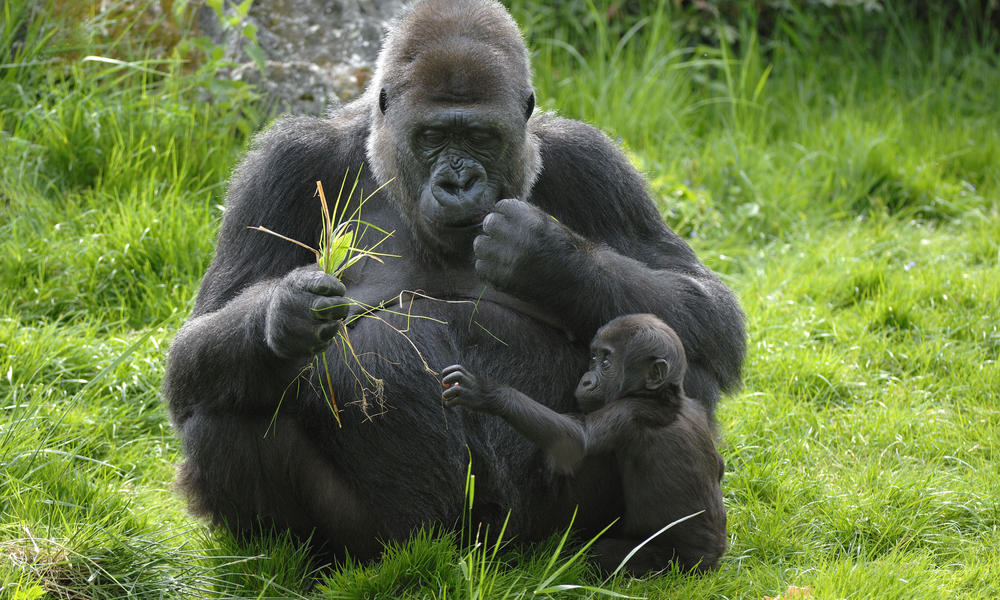 Equatorial Guinea, Gabon, and the Republic of Congo. The mountain gorilla (Gorilla beringei beringei) is also a smaller gorilla that lives in mountainous regions with altitudes of 8,000 to 13,000 feet in the Democratic Republic of Congo, Uganda, and Rwanda. The mountain gorilla’s fur is thicker than that of its lowland cousin, but both have a primarily herbivorous diet and live in complex social groups. About half of the mountain gorilla population (estimated at about 700 individuals (National Geographic 2012) is found in the Bwindi Impenetrable National Park in Uganda.
The western lowland gorilla sub-species is critically endangered. Exact population numbers are not known, because it’s so difficult to get into their habitat. What is known is that the population seems to have decreased by up to 60% in the last 20 to 25 years. Threats to the lowland gorillas include poaching and disease (the Ebola virus). The good news is, as reported by World Wildlife Fund on October 11, the Republic of Congo announced that it will designate over 7 million acres of wetland areas such as marshes, wetland forests, and lakes to protect the western lowland gorilla and other species such as chimpanzees, African elephants, and hippos! This brings the total protected wetlands acreage in the Republic of Congo to 29 million – about the size of Ohio!
The mountain gorilla is also critically endangered, threatened by war, habitat loss, disease, poaching, and charcoal making. But there’s good news here too! The World Wildlife Fund reported on November 13 that “a recent census by the Uganda Wildlife Authority identified 880 mountain gorillas, an increase from the 786 estimated in 2010.” (WWF 2012 Mountain Gorilla).
Why are gorillas worth saving? Well, to start, they’re our distant cousins who use tools and live within complex social structures. If you need an ecological or economic reason, here they are: as stated in Wildlife Heroes (2012), “Due to the large quantities of plant matter they consume, gorillas play an important role in the shaping of plant and forest environments. Tourism to view gorillas in their wild habitat is an important part of the range country economies, bringing millions of dollars each year into Rwanda, Uganda, and Democratic Republic of Congo.”
What can you do to help? Go to the World Wildlife fund website or check out this list of organizations working to protect the gorillas and their habitats.
Interested in weekly endangered species updates? Be sure to “like” us on Facebook!
Sources:
National Geographic. 2012. Mountain Gorilla website. Accessed 11/18/2012. http://animals.nationalgeographic.com/animals/mammals/mountain-gorilla/
Scardina, J. and J. Flocken. 2012. Wildlife Heroes. Philadelphia PA, Running Press Book Publishers. 264 pp.
World Wildlife Fund. 2012. Western Lowland Gorilla website. Accessed 11/19/2012. http://worldwildlife.org/species/western-lowland-gorilla (photo and text credit)
World Wildlife Fund. 2012. Mountain Gorilla website. Accessed 11/19/2012. http://worldwildlife.org/species/mountain-gorilla
Subscribe to:
Posts (Atom)