This week’s meat-free Friday recipe is adapted from a Michael Lomonaco recipe I found on the Today Show’s website. Perfect for a cool winter day; be sure to pair with cornbread!
Ingredients:
2 packages Quorn Chick’n Tenders
1/4 cup olive oil (I usually use a little more)
2 large onions, chopped
2 red peppers, seeded and chopped
2 tblsp ground cumin (I usually use a little more)
2 tblsp chili powder
2 tblsp jar garlic
2 small cans Hatch green chilis, one spicy and one mild
1 15 oz. can crushed tomatoes
1 32 oz. packages vegetable broth
1 28 oz can hominy
garnish: chopped cilantro, chopped green onions, sour cream
Instructions:
1) Heat oil in a large pot. Saute chick’n tenders, onion, red pepper until tenders are slightly brown.
2) Add cumin, chili powder, garlic, green chilis, and tomatoes. Saute for another couple of minutes.
3) Add vegetable broth, plus 2 cups of water. Simmer for about 20 minutes.
4) Add hominy and continue to cook until warm. Enjoy garnished with cilantro, green onions, and sour cream!
Friday, November 30, 2012

Wednesday, November 28, 2012
Something to roar about!
The Scientific American blog this week reported that the African lion (Panthera leo leo) is now closer to protection under the U.S. Endangered Species Act (ESA). Protection under the ESA doesn’t prohibit Americans from hunting African lions, but it would prohibit  those hunters from bringing their trophies home to the U.S. Why did the U.S. Fish and Wildlife Service move the big cats one step closer to protection? As stated in the Scientific American blog, “ African lion populations have declined by about 50 percent over the past three decades. Current estimates put the total number of the big cats at fewer than 35,000. Trophy hunting hardly poses the greatest threat to lions—which also suffer from habitat loss, the bushmeat trade, exotic diseases, conflict with livestock farmers and the often illegal trade in lion parts for use in traditional medicine, most of which is fueled by poaching and smuggling—but when you add up the numbers, hunters do have a significant impact on the big cats. According to data gathered for last year’s petition, more than 7,000 lion body parts were traded internationally between 1999 and 2008 for recreational trophy hunting purposes, representing more than 5,600 lions. The vast majority of those trophies were imported into the U.S. by, or on behalf of, American hunters.”
If you’d like to learn more about African lions and see the work of two nature photographers who have been documenting lion behavior for over 30 years, check out this week’s report on 60 minutes:
Sources:
Scientific American. 2012. African Lions Move Closer to U.S. Endangered Species Act Protection. November 27, 2012. Accessed November 28, 2012. http://blogs.scientificamerican.com/extinction-countdown/2012/11/27/african-lions-move-closer-endangered-species-act-protection/
those hunters from bringing their trophies home to the U.S. Why did the U.S. Fish and Wildlife Service move the big cats one step closer to protection? As stated in the Scientific American blog, “ African lion populations have declined by about 50 percent over the past three decades. Current estimates put the total number of the big cats at fewer than 35,000. Trophy hunting hardly poses the greatest threat to lions—which also suffer from habitat loss, the bushmeat trade, exotic diseases, conflict with livestock farmers and the often illegal trade in lion parts for use in traditional medicine, most of which is fueled by poaching and smuggling—but when you add up the numbers, hunters do have a significant impact on the big cats. According to data gathered for last year’s petition, more than 7,000 lion body parts were traded internationally between 1999 and 2008 for recreational trophy hunting purposes, representing more than 5,600 lions. The vast majority of those trophies were imported into the U.S. by, or on behalf of, American hunters.”If you’d like to learn more about African lions and see the work of two nature photographers who have been documenting lion behavior for over 30 years, check out this week’s report on 60 minutes:
Sources:
Scientific American. 2012. African Lions Move Closer to U.S. Endangered Species Act Protection. November 27, 2012. Accessed November 28, 2012. http://blogs.scientificamerican.com/extinction-countdown/2012/11/27/african-lions-move-closer-endangered-species-act-protection/
Sunday, November 25, 2012
We adopted a stream–and it’s pretty sick….

The Fall count happened today, and it was a real bummer. Our stream is not looking good. All we found were 4 fly larvae and one oligochaete worm. 
1) Erosion – Often, in developed areas, we try to channel water to specific waterways, rather than allowing the water to flow through smaller streams, floodplains, wetlands, or other soil on its way to the larger tributaries. We bury smaller streams to allow development and move the path of the stormwater. Additionally, hard surfaces (roofs, roads, sidewalks) keep the ground from absorbing water. By shunting stormwater to just a few streams, we really increase the speed and power of water as it moves through these streams. If you see a stream bank that looks like this, 
2) Pollution and sedimentation – Pollution in streams comes from several sources:
- sedimentation from the erosion (see the picture, above)
- phosphorous and nitrogen from overuse of lawn fertilizers
- oils and other toxins that run directly off roads, roofs, and driveways and into waterways (no slowing down and cleaning through wetlands or other soils)
- large trash carelessly discarded or stuffed down storm drains (see the plastic bags stuck in the tree roots in the photo above)
Our walk back home after our stream monitoring session was a quiet one. Needless to say, we were disappointed and sad to see the condition of our stream. This is a great illustration of why we greenmomsters need to get involved, change the status quo, and protect our children’s environment. Is there hope? Yes! Our local Soil and Water Conservation District is working hard to restore and stabilize eroded stream banks. Additionally, folks are organizing to save the streams that are still healthy. Northern VA was host to such an effort recently when a group of concerned citizens saved “Tyson’s Last Forest” from a popular highway project. It can be done!
We’ll keep you posted regarding our stream (we may be assigned a new stream). See you in the spring!
Friday, November 23, 2012
Meat-Free Friday–the post-Thanksgiving edition!
It’s the day after Thanksgiving, and you still have LOTS of leftovers. There will be no experimenting with meat-free recipes. So instead, today I’m posting a terrific seasonal recipe for persimmon bread that you can pair with some hard-boiled eggs and a fruit salad for a delicious holiday weekend breakfast (yes Thom, I know breakfast breads are always meatless!). For this bread, I’ve adapted a David Lebovitz recipe that he adapted from Beard on Bread. Photo is also from David Lebovitz. Make lots of this bread – it freezes well! Have a great holiday weekend!
Ingredients
3 1/2 cups flour
1 tsp salt
2 tsp baking soda
1 tsp ground nutmeg
2 1/2 cups sugar
1 cup melted unsalted butter, cooled to room temperature
4 eggs, beaten
1 cup orange juice
2 cups crushed persimmons (Scoop the fruit out of very ripe persimmons and smash them with a potato masher on a cutting board. If your persimmons are still pretty hard, put them in the freezer for a day or two and then thaw – they’ll be soft and ready to mash)
2 cups walnut pieces
2 cups raisins
Instructions
1) Grease two loaf pans. Preheat oven to 350.
2) Sift together the first five ingredients in a large bowl
3) Make a well in the center of the dry ingredients and add butter, eggs, orange juice, and persimmons. Stir well.
4) Add in nuts and raisins and stir again.
5) Bake 1 hour, or until a knife inserted in the center comes out clean.
for a delicious holiday weekend breakfast (yes Thom, I know breakfast breads are always meatless!). For this bread, I’ve adapted a David Lebovitz recipe that he adapted from Beard on Bread. Photo is also from David Lebovitz. Make lots of this bread – it freezes well! Have a great holiday weekend!Ingredients
3 1/2 cups flour
1 tsp salt
2 tsp baking soda
1 tsp ground nutmeg
2 1/2 cups sugar
1 cup melted unsalted butter, cooled to room temperature
4 eggs, beaten
1 cup orange juice
2 cups crushed persimmons (Scoop the fruit out of very ripe persimmons and smash them with a potato masher on a cutting board. If your persimmons are still pretty hard, put them in the freezer for a day or two and then thaw – they’ll be soft and ready to mash)
2 cups walnut pieces
2 cups raisins
Instructions
1) Grease two loaf pans. Preheat oven to 350.
2) Sift together the first five ingredients in a large bowl
3) Make a well in the center of the dry ingredients and add butter, eggs, orange juice, and persimmons. Stir well.
4) Add in nuts and raisins and stir again.
5) Bake 1 hour, or until a knife inserted in the center comes out clean.
Wednesday, November 21, 2012
All Good Green Gifts (yes, that’s a Godspell reference, musical theater fans!)
Looking out at the environmental landscape, I’ve seen a few biodiversity headlines for which I’m very grateful!

- Mountain Gorilla Population Increase – World Wildlife Fund reports that the mountain gorilla population has increased by nearly 100 individuals in the past two years!
- Illegal Logging Decreased in Monarch Wintering Grounds – In August Earth Week reported that, due to increased patrols, aerial patrols showed no loss of forest in the Michoacan butterfly sanctuary this year. This is the first time it’s happened since the sanctuary was established in 2000!
- Red-Cockaded Woodpecker Population Increase – From 1993 to 2006, active clusters have increased from around 4,000 to over 6,000!
- Blue Crab Rebound in the Chesapeake Bay – After a record low crab population count in 2007, the Chesapeake Bay program reported, “Winter estimates place the adult female blue crab population at 97 million, based on a dredge survey taken at almost 1,500 sites throughout the Bay. The survey also measured more juveniles than have been counted in the past two decades.” (Chesapeake Bay Program 2012)
- America’s Largest Marine Sanctuary is Now Even Bigger! In October, NOAA finalized the expansion of the Fagatele Bay National Marine Sanctuary in American Samoa. Now called the National Marine Sanctuary of American Samoa, the protected area is as large as the state of Maryland!

Chesapeake Bay Program. 2012. “Chesapeake Bay News, Six Things the Chesapeake Bay is Thankful For.” Web. Accessed 11/20/2012. http://www.chesapeakebay.net/blog/post/6_things_the_bay_watershed_is_thankful_for_in_2012
Discovery Communications. 2012. “Biggest U.S. Marine Sanctuary Expands: Big Pics.” Web. Accessed 11/20/2012. http://news.discovery.com/earth/us-largest-marine-sanctuary-121120.html
Earth Environmental Service. 2012. “EarthWeek, Diary of a Planet.” Web. Accessed 11/20/2012. http://www.earthweek.com/2012/ew120824/ew120824f.html
U.S. Fish and Wildlife Service. 2012. Red-cockaded woodpecker recovery website. Accessed 10/19/2012. http://www.fws.gov/rcwrecovery/.
World Wildlife Fund. 2012. Mountain Gorilla website. Accessed 11/19/2012. http://worldwildlife.org/species/mountain-gorilla
Monday, November 19, 2012
Grateful for Gorillas!
This week, I’m grateful for gorillas and the good news about their protection! The western lowland gorilla (Gorilla gorilla gorilla – see photo), is a relatively small gorilla (4-5 1/2 ft tall and up to 440 lbs) that lives in the dense rainforests of Cameroon, the Central African Republic, the Democratic Republic of Congo,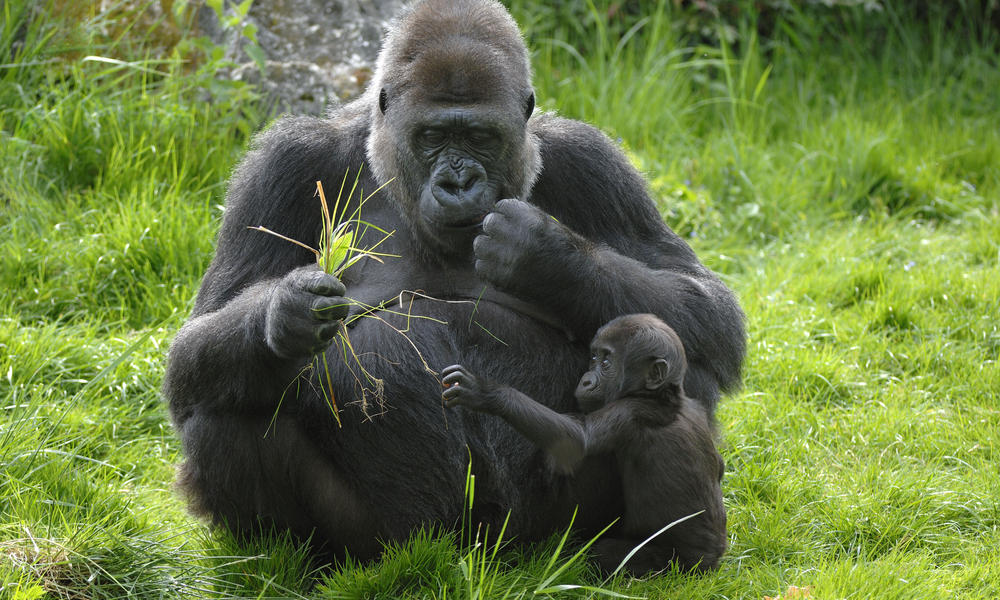 Equatorial Guinea, Gabon, and the Republic of Congo. The mountain gorilla (Gorilla beringei beringei) is also a smaller gorilla that lives in mountainous regions with altitudes of 8,000 to 13,000 feet in the Democratic Republic of Congo, Uganda, and Rwanda. The mountain gorilla’s fur is thicker than that of its lowland cousin, but both have a primarily herbivorous diet and live in complex social groups. About half of the mountain gorilla population (estimated at about 700 individuals (National Geographic 2012) is found in the Bwindi Impenetrable National Park in Uganda.
The western lowland gorilla sub-species is critically endangered. Exact population numbers are not known, because it’s so difficult to get into their habitat. What is known is that the population seems to have decreased by up to 60% in the last 20 to 25 years. Threats to the lowland gorillas include poaching and disease (the Ebola virus). The good news is, as reported by World Wildlife Fund on October 11, the Republic of Congo announced that it will designate over 7 million acres of wetland areas such as marshes, wetland forests, and lakes to protect the western lowland gorilla and other species such as chimpanzees, African elephants, and hippos! This brings the total protected wetlands acreage in the Republic of Congo to 29 million – about the size of Ohio!
The mountain gorilla is also critically endangered, threatened by war, habitat loss, disease, poaching, and charcoal making. But there’s good news here too! The World Wildlife Fund reported on November 13 that “a recent census by the Uganda Wildlife Authority identified 880 mountain gorillas, an increase from the 786 estimated in 2010.” (WWF 2012 Mountain Gorilla).
Why are gorillas worth saving? Well, to start, they’re our distant cousins who use tools and live within complex social structures. If you need an ecological or economic reason, here they are: as stated in Wildlife Heroes (2012), “Due to the large quantities of plant matter they consume, gorillas play an important role in the shaping of plant and forest environments. Tourism to view gorillas in their wild habitat is an important part of the range country economies, bringing millions of dollars each year into Rwanda, Uganda, and Democratic Republic of Congo.”
What can you do to help? Go to the World Wildlife fund website or check out this list of organizations working to protect the gorillas and their habitats.
Interested in weekly endangered species updates? Be sure to “like” us on Facebook!
Sources:
National Geographic. 2012. Mountain Gorilla website. Accessed 11/18/2012. http://animals.nationalgeographic.com/animals/mammals/mountain-gorilla/
Scardina, J. and J. Flocken. 2012. Wildlife Heroes. Philadelphia PA, Running Press Book Publishers. 264 pp.
World Wildlife Fund. 2012. Western Lowland Gorilla website. Accessed 11/19/2012. http://worldwildlife.org/species/western-lowland-gorilla (photo and text credit)
World Wildlife Fund. 2012. Mountain Gorilla website. Accessed 11/19/2012. http://worldwildlife.org/species/mountain-gorilla
Friday, November 16, 2012
Meat-Free Friday–Dianna’s Down and Dirty Swimming Rama!
This week’s recipe comes to us from my good friend (we’ve known each other since 8th grade!!!) Dianna -- mother, mid-wife, and labor and delivery nurse extraordinaire! When Dianna isn’t busy with her family or welcoming new babies into the world, she’s often sharing her recipe ideas on Facebook. This week, we benefit from the culinary creativity of our fellow greenmomster, Dianna!

Ingredients:
1 cup peanut butter or prepared Thai peanut sauce
1 cup coconut milk
1 cup vegetable broth
chili sauce to taste
red pepper flakes to taste
1 can chickpeas, drained
2 cups or one bag Quorn Chick’n tenders
1 tblsp olive oil
3 cups pre-washed baby spinach
3 cups cooked rice
Instructions:
1) Saute Chick’n tenders in olive oil until slightly browned. Remove from pan.
2) Combine peanut butter/peanut sauce, vegetable broth, chili sauce and red pepper flakes in pan. Simmer until thick and well-blended.
3) Add chickpeas, chick’n tenders, and spinach to the peanut mixture. Warm for 10-15 minutes, stirring occasionally until spinach is cooked. Enjoy over rice!
Subscribe to:
Posts (Atom)