Showing posts with label polar bears. Show all posts
Showing posts with label polar bears. Show all posts
Wednesday, February 28, 2018
International Polar Bear Day!
It seems I was a bit early with my polar bear post this month, and now I'm a day late wishing you a wonderful International Polar Bear Day (it was yesterday), sponsored by Polar Bears International. No worries! We can celebrate polar bears every day! Step 1: Work to limit climate change through individual, local, and global action. Step 2: Take a moment to enjoy polar bears:

Monday, February 5, 2018
Mammal Monday -- 10 fun polar bear facts!
I watched a few political talk shows yesterday, listening as the Republican pundits encouraged us to pay attention to the administration's accomplishments. I agree completely! One of this administration's "accomplishments" is the opening of public lands to oil and gas exploration via "streamlining" of permitting processes, including the reduction of time that the U.S. taxpayers have to comment on finalized leases. Another accomplishment is the opening of the Arctic National Wildlife Refuge to oil and gas drilling to pay for the tax reform. And we should definitely remember the accomplishment of pulling the U.S. out of the Paris Climate accords. For today's Mammal Monday, let's take a look at a repost about a species that will be affected by the current administration's accomplishments -- the polar bear!
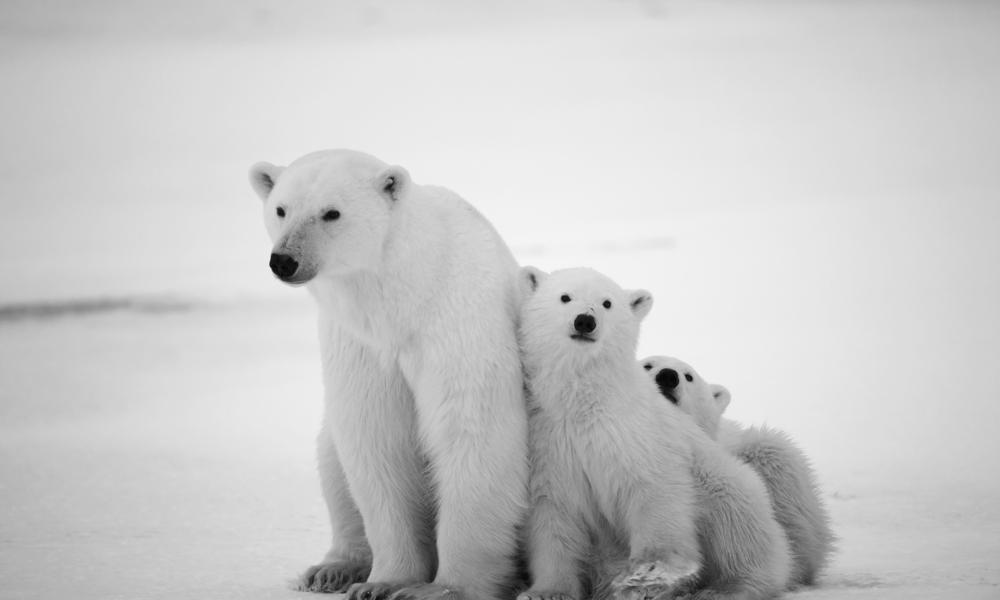
It’s winter, so let’s look at the polar bear (Ursus maritimus)(photo from http://worldwildlife.org/species/polar-bear). Here are 10 things to know about polar bears:
- These powerful symbols of the arctic weigh between 500 and 1000 lbs (and even up to 1400 lbs!),
- Polar bears feed primarily on ringed seals (U.S. FWS 2009).
- Polar bears are extremely strong swimmers
- Polar bears can live from 25 to 30 years in the
 wild.
wild. - To live in the harsh arctic climate, they have evolved several different adaptations to stay warm – they’ve got a thick layer of blubber and are covered in a thick layer of insulating fur. Although the fur is white (providing camouflage in their white, icy environment), the skin underneath is actually black, allowing it to absorb the sun’s rays. Even the soles of the polar bear’s feet are covered in fur (National Geographic ND).
- At around 3-5 years of age, polar bears are ready to reproduce (U.S. FWS 2009). Females dig dens in the arctic ice and give birth during the winter, usually to twins.
- Polar bear cubs stay with their mothers for over two years, in order to learn survival skills. All parental care is given by the female; in fact, the females must protect the young from the males who have been known to kill the cubs (National Geographic ND).
- The polar bear population is currently estimated at 20,000-25,000 (U.S. FWS 2009).
- Polar bears are listed under the Endangered Species Act as threatened (U.S. FWS 2013) and listed on Appendix II of CITES, with primary threats to the population being the loss of sea ice, due to climate change. Several international agreements are in place to try to protect the polar bear and its habitat.
- Canada is the only nation with polar bears that currently allows sports hunting of this species (Washington Post 2013).
Why should we care about the polar bear? As stated on the World Wildlife Federation’s website: “Polar bears are at the top of the food chain and have an important role in the overall health of the marine environment. Over thousands of years, polar bears have also been an important part of the cultures and economies of Arctic peoples. Polar bears depend on sea ice for their existence and are directly impacted by climate change—serving as important indicator species.” To learn more about the polar bear and what you can do to help, be sure to visit: http://worldwildlife.org/species/polar-bear
Sources:
Eilperin, J.. 2013. “U.S. Proposal to Protect Polar Bears Fails.” Washington Post, March 8, 2013.
National Geographic. ND. “Polar Bear Ursus maritimus” Accessed online 3/8/2013. http://animals.nationalgeographic.com/animals/mammals/polar-bear/
U.S. Fish and Wildlife Service. 2013. “Species Profile. Polar Bear (Ursus Maritimus)” Last updated 3/8/2013. Accessed online 3/8/2012. http://ecos.fws.gov/speciesProfile/profile/speciesProfile.action?spcode=A0IJ
U.S. Fish and Wildlife Service. 2009. “Polar Bear Ursus maritimus” Last updated October 2009. Accessed online 3/8/2013. http://www.fws.gov/endangered/esa-library/pdf/polar_bear.pdf
World Wildlife Fund. 2013. “Polar Bear” Accessed online 3/8/2013. http://worldwildlife.org/species/polar-bear
Sunday, January 28, 2018
Polar Plunge 2018!

It wasn't as cold as last year, but it was plenty cold enough for me (I'm the wimpy looking person in the polar bear hat, who has already turned around and headed for the shore). We had a great day for the Chesapeake Climate Action Network's annual "Keep Winter Cold" Polar Plunge! This group of hardy volunteers raised money to help with local efforts to slow and stop the causes of climate change, such as offshore drilling and fracking pipelines. The funds also go to support efforts to develop sustainable technologies such as wind and solar. Great causes all around, but it's also a great chance for creative folks to show off a little:


Wednesday, November 15, 2017
Drilling in ANWR -- raising its ugly head again
This week, Senate Energy and Natural Resources Committee Chairman LIsa Murkowski (AK -- R), introduced a bill that would open the Arctic National Wildlife Refuge (ANWR) to oil and gas drilling. There are so many reasons that this legislation is a lousy idea:
- ANWR is considered by many "the Serengeti of the Arctic", where large herds of herbivores roam, similar in size to those found in Africa
- we don't need to be drilling for more fossil fuels; we need to develop renewable energy sources (not an easy goal, so everyone needs to be on board -- I'll post about that later)
- we're exploiting our valuable natural environment to pay for the proposed tax cuts -- the ones that will make businesses and the rich richer
Just when we thought ANWR was off the table (it's been off the table for at least 20 years), here they come again. Be sure to contact your Senator to tell them that this legislation is a step backward. And now let's take a look at a re-post of a species that will be negatively impacted by this legislative mistake:
This week’s endangered species is the polar bear (Ursus maritimus)(photo from http://worldwildlife.org/species/polar-bear). These powerful symbols of the arctic weigh between 500 and 1000 lbs (and even up to 1400 lbs!), feeding primarily on ringed seals (U.S. FWS 2009). Polar bears are extremely strong swimmers and can live from 25 to 30 years in the wild. To live in the harsh arctic climate, they have evolved several different adaptations to stay warm – they’ve got a thick layer of blubber and are covered in a thick layer of insulating fur. Although the fur is white (providing camouflage in their white, icy environment), the skin underneath is actually black, allowing it to absorb the sun’s rays. Even the soles of the polar bear’s feet are covered in fur (National Geographic ND).
wild. To live in the harsh arctic climate, they have evolved several different adaptations to stay warm – they’ve got a thick layer of blubber and are covered in a thick layer of insulating fur. Although the fur is white (providing camouflage in their white, icy environment), the skin underneath is actually black, allowing it to absorb the sun’s rays. Even the soles of the polar bear’s feet are covered in fur (National Geographic ND).
At around 3-5 years of age, polar bears are ready to reproduce (U.S. FWS 2009). Females dig dens in the arctic ice and give birth during the winter, usually to twins. The young stay with the female for over two years, in order to learn survival skills. All parental care is given by the female; in fact, the females must protect the young from the males who have been known to kill the cubs (National Geographic ND).
The polar bear population is currently estimated at 20,000-25,000 (U.S. FWS 2009). Polar bears are listed under the Endangered Species Act as threatened (U.S. FWS 2013) and listed on Appendix II of CITES, with primary threats to the population being the loss of sea ice, due to climate change. Several international agreements are in place to try to protect the polar bear and its habitat; Canada is the only nation with polar bears that currently allows sports hunting of this species (Washington Post 2013). Unfortunately, there was recently a set-back for polar bear protection at the international meeting of the Convention on International Trade in Endangered Species (CITES) of Wild Fauna and Flora. The group rejected a U.S. proposal to ban the global trade of polar bear parts. Canadian Inuits led the opposition (citing the need for international trade to protect their economy); 42 countries opposed the U.S. proposal, 38 voted in favor, and 46 members, including the 27 members of the European Union, abstained. Truly a disappointing day in the history of polar bear conservation.
Why should we care about the polar bear? As stated on the World Wildlife Federation’s website: “Polar bears are at the top of the food chain and have an important role in the overall health of the marine environment. Over thousands of years, polar bears have also been an important part of the cultures and economies of Arctic peoples. Polar bears depend on sea ice for their existence and are directly impacted by climate change—serving as important indicator species.” To learn more about the polar bear and what you can do to help, be sure to visit: http://worldwildlife.org/species/polar-bear
Sources:
Eilperin, J.. 2013. “U.S. Proposal to Protect Polar Bears Fails.” Washington Post, March 8, 2013.
National Geographic. ND. “Polar Bear Ursus maritimus” Accessed online 3/8/2013. http://animals.nationalgeographic.com/animals/mammals/polar-bear/
U.S. Fish and Wildlife Service. 2013. “Species Profile. Polar Bear (Ursus Maritimus)” Last updated 3/8/2013. Accessed online 3/8/2012. http://ecos.fws.gov/speciesProfile/profile/speciesProfile.action?spcode=A0IJ
U.S. Fish and Wildlife Service. 2009. “Polar Bear Ursus maritimus” Last updated October 2009. Accessed online 3/8/2013. http://www.fws.gov/endangered/esa-library/pdf/polar_bear.pdf
World Wildlife Fund. 2013. “Polar Bear” Accessed online 3/8/2013. http://worldwildlife.org/species/polar-bear
Wednesday, January 20, 2016
10 fun polar bear facts!
Be sure to “Like” greenmomster on facebook for all the latest posts!
It’s winter, so let’s look at the polar bear (Ursus maritimus)(photo from http://worldwildlife.org/species/polar-bear). Here are 10 things to know about polar bears:
- These powerful symbols of the arctic weigh between 500 and 1000 lbs (and even up to 1400 lbs!),
- Polar bears feed primarily on ringed seals (U.S. FWS 2009).
- Polar bears are extremely strong swimmers
- Polar bears can live from 25 to 30 years in the wild.
- To live in the harsh arctic climate, they have evolved several different adaptations to stay warm – they’ve got a thick layer of blubber and are covered in a thick layer of insulating fur. Although the fur is white (providing camouflage in their white, icy environment), the skin underneath is actually black, allowing it to absorb the sun’s rays. Even the soles of the polar bear’s feet are covered in fur (National Geographic ND).
- At around 3-5 years of age, polar bears are ready to reproduce (U.S. FWS 2009). Females dig dens in the arctic ice and give birth during the winter, usually to twins.
- Polar bear cubs stay with their mothers for over two years, in order to learn survival skills. All parental care is given by the female; in fact, the females must protect the young from the males who have been known to kill the cubs (National Geographic ND).
- The polar bear population is currently estimated at 20,000-25,000 (U.S. FWS 2009).
- Polar bears are listed under the Endangered Species Act as threatened (U.S. FWS 2013) and listed on Appendix II of CITES, with primary threats to the population being the loss of sea ice, due to climate change. Several international agreements are in place to try to protect the polar bear and its habitat.
- Canada is the only nation with polar bears that currently allows sports hunting of this species (Washington Post 2013).
Why should we care about the polar bear? As stated on the World Wildlife Federation’s website: “Polar bears are at the top of the food chain and have an important role in the overall health of the marine environment. Over thousands of years, polar bears have also been an important part of the cultures and economies of Arctic peoples. Polar bears depend on sea ice for their existence and are directly impacted by climate change—serving as important indicator species.” To learn more about the polar bear and what you can do to help, be sure to visit: http://worldwildlife.org/species/polar-bear
Sources:
Eilperin, J.. 2013. “U.S. Proposal to Protect Polar Bears Fails.” Washington Post, March 8, 2013.
National Geographic. ND. “Polar Bear Ursus maritimus” Accessed online 3/8/2013. http://animals.nationalgeographic.com/animals/mammals/polar-bear/
U.S. Fish and Wildlife Service. 2013. “Species Profile. Polar Bear (Ursus Maritimus)” Last updated 3/8/2013. Accessed online 3/8/2012. http://ecos.fws.gov/speciesProfile/profile/speciesProfile.action?spcode=A0IJ
U.S. Fish and Wildlife Service. 2009. “Polar Bear Ursus maritimus” Last updated October 2009. Accessed online 3/8/2013. http://www.fws.gov/endangered/esa-library/pdf/polar_bear.pdf
World Wildlife Fund. 2013. “Polar Bear” Accessed online 3/8/2013. http://worldwildlife.org/species/polar-bear
Sunday, July 12, 2015
Endangered species, fossil fuels, and cool lizards
A repost from January 2012 – enjoy! And be sure to “like” greenmomster on Facebook!
Just this past week, the Endangered Species Coalition published a report on the 10 U.S. species most threatened by fossil fuel production and use.  Included in the list are well-known species such as polar bears and whooping cranes, little known species such as tan riffleshell and Kentucky arrow darter, and some of my favorites like the Kemp’s Ridley sea turtle, dunes sagebrush lizard, and Wyoming pocket gopher. Assuming that we care about these species and their roles in the ecosystem (see post "A few misconceptions about endangered species" 12/31/11), what’s a person to do? I’m not able to make national decisions about our country’s energy sources (although in a “Desocracy” we’d concentrate heavily on renewables and conservation). But remembering that our country makes up approximately 5% of the world’s population, but uses over 20% of the world’s oil, we each have an important role to play in protecting the listed endangered species.
Start by figuring out your contribution to global warming (produced by your use of fossil fuels) and where you might be able to cut back. Take the Ecological Footprint quiz --you’ll find out how many Earths would be needed to sustain your lifestyle if everyone on Earth lived as you do. Next, check out the “Low Hanging Fruit” tab. There you’ll find tips on reducing your fossil fuel use by reducing plastics, eating less meat, driving less, conserving heat and air conditioning, using reusable bags (yes, those plastic bags are made of oil), and using your microwave. For more tips and fun facts, check out this great list of energy saving tips. To educate yourself more about “big picture” ideas on cutting oil use (mostly transportation) check out the suggestions from the Council on Foreign Relations and National Resources Defense Council. It may seem a topic that is too big to deal with, but we all have to do something, big or small – even DOD is wrestling with energy security and conservation.
So let’s each pick one thing this week that will reduce use of oil. I’m going to walk a little more this week, because I think those sagebrush lizards are worth saving.
Monday, March 11, 2013
The cold shoulder for polar bears
Be sure to “Like” greenmomster on facebook for all the latest posts!
This week’s endangered species is the polar bear (Ursus maritimus)(photo from http://worldwildlife.org/species/polar-bear). These powerful symbols of the arctic weigh between 500 and 1000 lbs (and even up to 1400 lbs!), feeding primarily on ringed seals (U.S. FWS 2009). Polar bears are extremely strong swimmers and can live from 25 to 30 years in the wild. To live in the harsh arctic climate, they have evolved several different adaptations to stay warm – they’ve got a thick layer of blubber and are covered in a thick layer of insulating fur. Although the fur is white (providing camouflage in their white, icy environment), the skin underneath is actually black, allowing it to absorb the sun’s rays. Even the soles of the polar bear’s feet are covered in fur (National Geographic ND).
At around 3-5 years of age, polar bears are ready to reproduce (U.S. FWS 2009). Females dig dens in the arctic ice and give birth during the winter, usually to twins. The young stay with the female for over two years, in order to learn survival skills. All parental care is given by the female; in fact, the females must protect the young from the males who have been known to kill the cubs (National Geographic ND).
The polar bear population is currently estimated at 20,000-25,000 (U.S. FWS 2009). Polar bears are listed under the Endangered Species Act as threatened (U.S. FWS 2013) and listed on Appendix II of CITES, with primary threats to the population being the loss of sea ice, due to climate change. Several international agreements are in place to try to protect the polar bear and its habitat; Canada is the only nation with polar bears that currently allows sports hunting of this species (Washington Post 2013). Unfortunately, there was recently a set-back for polar bear protection at the international meeting of the Convention on International Trade in Endangered Species (CITES) of Wild Fauna and Flora. The group rejected a U.S. proposal to ban the global trade of polar bear parts. Canadian Inuits led the opposition (citing the need for international trade to protect their economy); 42 countries opposed the U.S. proposal, 38 voted in favor, and 46 members, including the 27 members of the European Union, abstained. Truly a disappointing day in the history of polar bear conservation.
Why should we care about the polar bear? As stated on the World Wildlife Federation’s website: “Polar bears are at the top of the food chain and have an important role in the overall health of the marine environment. Over thousands of years, polar bears have also been an important part of the cultures and economies of Arctic peoples. Polar bears depend on sea ice for their existence and are directly impacted by climate change—serving as important indicator species.” To learn more about the polar bear and what you can do to help, be sure to visit: http://worldwildlife.org/species/polar-bear
Sources:
Eilperin, J.. 2013. “U.S. Proposal to Protect Polar Bears Fails.” Washington Post, March 8, 2013.
National Geographic. ND. “Polar Bear Ursus maritimus” Accessed online 3/8/2013. http://animals.nationalgeographic.com/animals/mammals/polar-bear/
U.S. Fish and Wildlife Service. 2013. “Species Profile. Polar Bear (Ursus Maritimus)” Last updated 3/8/2013. Accessed online 3/8/2012. http://ecos.fws.gov/speciesProfile/profile/speciesProfile.action?spcode=A0IJ
U.S. Fish and Wildlife Service. 2009. “Polar Bear Ursus maritimus” Last updated October 2009. Accessed online 3/8/2013. http://www.fws.gov/endangered/esa-library/pdf/polar_bear.pdf
World Wildlife Fund. 2013. “Polar Bear” Accessed online 3/8/2013. http://worldwildlife.org/species/polar-bear
Tuesday, February 28, 2012
International Polar Bear Day!
Polar Bear Update -- February 27 was International Polar Bear Day! In celebration of this special day, check out the following:
- Why should we care about endangered species, including polar bears, anyway? Read my post on the topic.
- The new all-Siku, all-the-time (sort of) web cam!
- Polar Bears International with info on things you can do to help save polar bears

Monday, January 23, 2012
Endangered Species, Fossil Fuels, and Cool Lizards
Just this past week, the Endangered Species Coalition published a report on the 10 U.S. species most threatened by fossil fuel production and use. Included in the list are well-known species such as polar bears and whooping cranes, little known species such as tan riffleshell and Kentucky arrow darter, and some of my favorites like the Kemp’s Ridley sea turtle, dunes sagebrush lizard, and Wyoming pocket gopher. Assuming that we care about these species and their roles in the ecosystem (see post "A few misconceptions about endangered species" 12/31/11), what’s a person to do? I’m not able to make national decisions about our country’s energy sources (although in a Desocracy we’d concentrate heavily on renewables and conservation). But remembering that our country makes up approximately 5% of the world’s population, but uses over 20% of the world’s oil, we each have an important role to play in protecting the listed endangered species. Start by figuring out your contribution to global warming (produced by your use of fossil fuels) and where you might be able to cut back. Take the Ecological Footprint quiz --you’ll find out how many Earths would be needed to sustain your lifestyle if everyone on Earth lived as you do. Next, check out the “Low Hanging Fruit” tab. There you’ll find tips on reducing your fossil fuel use by reducing plastics, eating less meat, driving less, conserving heat and air conditioning, using reusable bags (yes, those plastic bags are made of oil), and using your microwave. For more tips and fun facts, check out this great list of energy saving tips. To educate yourself more about “big picture” ideas on cutting oil use (mostly transportation) check out the suggestions from the Council on Foreign Relations and National Resources Defense Council. It may seem a topic that is too big to deal with, but we all have to do something, big or small – even DOD is wrestling with energy security and conservation.
So let’s each pick one thing this week that will reduce use of oil. I’m going to walk a little more this week, because I think those sagebrush lizards are worth saving.
Saturday, December 31, 2011
A few misconceptions about endangered species….
 |
| source: Today Show website. 12/31/11. |
Misconception #1 -- Species have always gone extinct, so we don’t need to worry right now. True, species have always gone extinct. Scientists are not concerned about the fact of extinction; it’s the rate of extinction that is a concern. The USFWS, in its pamphlet “Why Save Endangered Species?”, states “Biologists estimate that since the Pilgrims landed at Plymouth Rock in 1620, more than 500 species, subspecies, and varieties of our Nation’s plants and animals have become extinct.” Wow! Current estimates of the current rate of species extinctions are 100 to 1000 times the natural rate which is estimated to be between 1 every year to 100 years. That means that we’re living in a time of mass species extinction, comparable to the extinction of the dinosaurs.
Misconception #2 -- Losing a species won’t affect humans. Species diversity is a critical element in ecosystem health. “Species diversity” is how many different species are found in a habitat and in what proportion they’re found. Some habitats have greater species diversity than others – think rainforest – but all habitats are healthiest when they contain as many different species as they can sustain. Think of a habitat as a fishing net, with each species being piece of rope that connects to other pieces to form the net. If one of the pieces of rope breaks and leaves a small hole, the net can probably be fixed and reused. But what if half the net is torn? It won’t be very useable. The same thing happens in a natural habitat; remove too many species and the habitat ceases to function. How many species can be lost, before the habitat doesn’t function? No one knows – is it an experiment we’re willing to try? The habitats around us provide many services such as medicinal and agricultural resources, clean water and air, and recreation. Healthy habitats benefit humans – they’re a necessity, not a luxury.
Misconception #3 – Once a species is on the endangered species list, it never comes off. Incorrect! Protections under the U.S. Endangered Species Act have led to the recovery of several species or populations of species, including the gray whale, the bald eagle, the brown pelican, and the gray wolf.
Misconception #4 – Pollution is the greatest threat to biodiversity. Actually, habitat loss is the greatest threat to biodiversity. With 7 billion humans on the planet, we take up a lot of space and we’re changing a lot of habitat to new uses.
Misconception #5 – There’s nothing I can do to protect the Earth’s biodiversity. (OK, I threw in an extra) In order to protect biodiversity and endangered species, we all have to make conscious choices about how we use resources. Check out the “low hanging fruit” section as a start. Visit www.myfootprint.org to discover new ways of decreasing your carbon footprint. Get involved in how our country produces energy – research the issue and write to your political representatives. One final thought from famous biologist E.O. Wilson, “The one process now going on that will take millions of years to correct is the loss of genetic and species diversity by the destruction of natural habitats. This is the folly our descendants are least likely to forgive us.” (From Brainy Quote. Web. 12/31/11. <http://www.brainyquote.com/quotes/authors/e/e_o_wilson_2.html#ixzz1i9a6zlii>)
Subscribe to:
Posts (Atom)