Monday, March 11, 2013

The cold shoulder for polar bears

Be sure to “Like” greenmomster on facebook for all the latest posts!

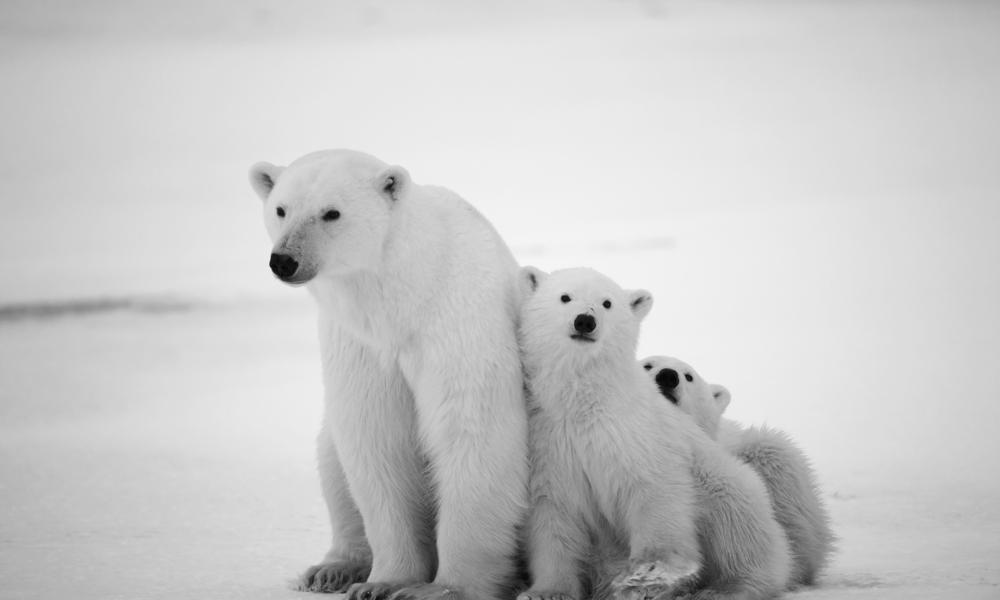
This week’s endangered species is the polar bear (Ursus maritimus)(photo from http://worldwildlife.org/species/polar-bear).   These powerful symbols of the arctic weigh between 500 and 1000 lbs (and even up to 1400 lbs!), feeding primarily on ringed seals (U.S. FWS 2009).  Polar bears are extremely strong swimmers and can live from 25 to 30 years in the Polar Bear Familywild.  To live in the harsh arctic climate, they have evolved several different adaptations to stay warm – they’ve got a thick layer of blubber and are covered in a thick layer of insulating fur.  Although the fur is white (providing camouflage in their white, icy environment), the skin underneath is actually black, allowing it to absorb the sun’s rays.  Even the soles of the polar bear’s feet are covered in fur (National Geographic ND).
At around 3-5 years of age, polar bears are ready to reproduce (U.S. FWS 2009).  Females dig dens in the arctic ice and give birth during the winter, usually to twins.  The young stay with the female for over two years, in order to learn survival skills.  All parental care is given by the female; in fact, the females must protect the young from the males who have been known to kill the cubs (National Geographic ND).

The polar bear population is currently estimated at 20,000-25,000 (U.S. FWS 2009).  Polar bears are listed under the Endangered Species Act as threatened (U.S. FWS 2013) and listed on Appendix II of CITES, with primary threats to the population being the loss of sea ice, due to climate change.  Several international agreements are in place to try to protect the polar bear and its habitat; Canada is the only nation with polar bears that currently allows sports hunting of this species (Washington Post 2013).  Unfortunately, there was recently a set-back for polar bear protection at the international meeting of the Convention on International Trade in Endangered Species (CITES) of Wild Fauna and Flora.  The group rejected a U.S. proposal to ban the global trade of polar bear parts.  Canadian Inuits led the opposition (citing the need for international trade to protect their economy); 42 countries opposed the U.S. proposal, 38 voted in favor, and 46 members, including the 27 members of the European Union, abstained.  Truly a disappointing day in the history of polar bear conservation. 

Why should we care about the polar bear?  As stated on the World Wildlife Federation’s website:  “Polar bears are at the top of the food chain and have an important role in the overall health of the marine environment. Over thousands of years, polar bears have also been an important part of the cultures and economies of Arctic peoples. Polar bears depend on sea ice for their existence and are directly impacted by climate change—serving as important indicator species.”   To learn more about the polar bear and what you can do to help, be sure to visit:  http://worldwildlife.org/species/polar-bear

Sources:

Eilperin, J.. 2013. “U.S. Proposal to Protect Polar Bears Fails.” Washington Post, March 8, 2013.

National Geographic.  ND.  “Polar Bear Ursus maritimus”  Accessed online 3/8/2013.   http://animals.nationalgeographic.com/animals/mammals/polar-bear/

U.S. Fish and Wildlife Service.  2013.  “Species Profile.  Polar Bear (Ursus Maritimus)”  Last updated 3/8/2013.  Accessed online 3/8/2012.  http://ecos.fws.gov/speciesProfile/profile/speciesProfile.action?spcode=A0IJ

U.S. Fish and Wildlife Service. 2009.  “Polar Bear Ursus maritimus”  Last updated October 2009.  Accessed online 3/8/2013.  http://www.fws.gov/endangered/esa-library/pdf/polar_bear.pdf

World Wildlife Fund.  2013.  “Polar Bear”  Accessed online 3/8/2013.  http://worldwildlife.org/species/polar-bear

Saturday, March 9, 2013

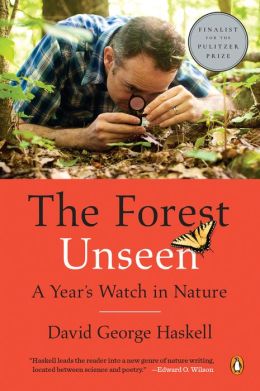
The Forest Unseen

Be sure to “Like” greenmomster on Facebook to get all the latest news!

The Forest Unseen by David George Haskell is a book that I truly enjoyed.  Dr. Haskell, a professor of biology at the University of the South, watched a small area of woods in Tennessee for an entire year and reports on the experience in this book.  Rather than taking a scientific, analytical approach to hisThe Forest Unseen: A Year's Watch in Nature study, Dr. Haskell tries to follow a more meditative approach, using the Tibetan mandalas as an example.  Here’s how he describes his adventure:

  “This book is a biologist’s response to the challenge of the Tibetan mandala, of Blake’s poems, of Lady Julian’s hazelnut.  Can the whole forest be seen through a small contemplative window of leaves, rocks, and water?  I have tried to find the answer to this question, or the start of an answer in a mandala made of old-growth forest in the hills of Tennessee.  The forest mandala is a circle a little over a meter across, the same size as the mandala that was created and swept away by the monks.  I chose the mandala’s location by walking haphazardly through the forest and stopping when I found a suitable rock on which to sit.  The area in front of the rock became the mandala, a place that I had never seen before, its promise mostly hidden by winter’s austere garb.”

I looked forward to reading this book each evening, wondering what new insights Dr. Haskell might have found in his daily mandala observations.  An expert naturalist, Dr. Haskell uses the mandala as a springboard for writing on topics as diverse as salamanders, snails, wind, katydids, fireflies,and fungi.  But what really sets this book apart is the writing.  Dr. Haskell is an award-winning poet, and this book is beautifully written.  I found myself underlining sentences and dog-earing pages, just to be able to refer back to his colorful descriptions of the fascinating world of nature (chloroplasts as “jewel boxes”).  Here’s how he describes the experience of viewing the mandala through a small magnifying glass:

“From my prone position I see the snail pause amid lichen flakes and black fungus spiking from the surface of oak leaves.  I peek over the lens and suddenly all is gone.  The change of scale is a wrench into a different world; the fungus is invisible,the snail is a valueless detail in a world dominated by bigger things.  I return to the lens world and re-discover the vivid tentacles, the snail’s black-and-silver grace.  The hand lens helps me harvest the world’s beauty, throwing my eyes wide open.  Layers of delight are hidden by the limitation s of everyday human vision.”

Dr. Haskell’s writing allows the reader to see many common creatures in a new way.  Although I was familiar with many of the organisms and processes he describes in the book, his colorful writing allowed me to see them through a new lens.  I learned interesting, new facts on almost every page.  For example, if you’ve ever seen a chickadee at a bird feeder, you know it’s a cute little bird.  That’s what we see when we’re looking at them, but what do they see?

“Chickadee eyes also perceive more colors than mine can.  I view the mandala with eyes that are equipped with three types of color receptor, giving me three primary colors and four main combinations of primary colors.  Chickadees have an extra color receptor that detects ultraviolet light.  This gives chickadees four primary colors and eleven main combinations, expanding the range of color vision beyond what humans can experience or even imagine.  Bird color receptors are also equipped with tinted oil droplets that act as light filters, allowing only a narrow range of colors to stimulate each receptor.  This increases the precision of color vision.  We lack these filters, so even within the range of light visible to humans. birds are better able to discriminate subtle differences in color.  Chickadees live in a hyperrreality of color that is inaccessible to our dull eyes.  Here in the mandala, they use these abilities to find food.  Ultraviolet light reflects from the dried wild grapes that are sparsely scattered across the forest floor.  Wings of beetles and moths are sometimes tinged with ultraviolet, as are some caterpillars.  Even without the advantage of ultraviolet vision, insect camouflage is unmasked by slight imperfections detected by the birds’ precise perception of color.”

Dr. Haskell’s beautiful and descriptive writing are what set this book apart.  Definitely worth a read – you’ll learn much about the incredible natural world around us!

Friday, March 8, 2013

Takin’ tips from the W. Post!

Be sure to "like" us on Facebook, to get all the latest meat-free Friday recipes and other updates from greenmomster!

This week, the Washington Post Food section was all about vegetarian food!  So I’m posting a recipe from the section that I’m hoping to try in the next week – if you give it a go, let us know what you thought!
Roasted Cauliflower With Citrus-Tahini Sauce
The Washington Post, March 6, 2013

Ingredients:

  • 6 tablespoons olive oil
  • 1 whole head cauliflower (1 to 1 1/4 pounds)
  • Sea salt
  • Fresh juice of 2 lemons (about 1/2 cup)
  • Grated zest and juice of 1/2 orange
  • 1 cup water
  • 3/4 cup tahini
  • 2 medium onions, sliced thin
  • 2 cloves garlic, mashed
  • 1/2 cup pine nuts, toasted, for garnish (see NOTE)
  • 1/4 cup slivered or coarsely chopped pistachios, for garnish

Directions:

1)  Preheat the oven to 425 degrees. Use half of the oil to grease a rimmed baking sheet.
2) Discard the green leaves of the cauliflower, leaving the core intact. Cut the head into 4 equal, thick slices and lay them on the baking sheet. Turn to coat with the oil and season both sides lightly with salt. Roast for about 10 minutes or until the edges are crisp, then carefully turn the slices over and roast for 10 minutes or until the cauliflower slices are lightly browned.
3)  While the cauliflower is in the oven, combine the lemon juice, the orange juice and most of the zest, all of the water and the tahini to form a well-blended sauce. (The remaining zest will be used as a garnish.)
4)  Heat the remaining 3 tablespoons of oil in a large saute pan over medium heat. Add the onion and garlic; stir to coat, then cook for about 8 minutes, until softened and lightly colored.
5)  Pour the citrus-tahini sauce over the onion mixture. Once the sauce starts to bubble at the edges, stir until smooth, slightly thickened and well combined. Taste, and adjust the seasoning as needed.
6)  Transfer the cauliflower to a serving platter. Spoon the sauce and onion evenly over the slices. Garnish with the toasted pine nuts, pistachios and reserved orange zest.
NOTE: Toast the pine nuts in a small, dry skillet over medium-low heat until fragrant and lightly browned, shaking the skillet a few times so the nuts do not burn.

Recipe Source:

Adapted from "Modern Flavors of Arabia: Recipes and Memories From My Middle Eastern Kitchen," by Suzanne Husseini (Appetite by Random House, 2012).
Tested by Bonnie S. Benwick for The Washington Post.
E-mail the
Food Section with recipe questions.


Wednesday, March 6, 2013

3 Quick Links to Speak Out against the Keystone XL Pipeline

climatechange10This week, the State Department released its Supplemental Draft Environmental Impact Statement (EIS) regarding the completion of the Keystone XL pipeline.  If you’d like to get involved in the decision-making process regarding this project, here are three steps you should take.  Voice your opinions!

1)  First, take a quick review of the climate change issue from Climate Mama.

2)  Second, read the Executive Summary of the Draft Supplemental EIS regarding the Keystone XL pipeline project.

3)  Third, voice your opinion.  If you’d like to make general comments to the Obama administration, you can use the Sierra Club website (if their opinions are aligned with yours).  If you’d like to make more specific comments on the Draft Supplemental EIS (for instance, I had many comments regarding the endangered species section of the document), you can comment directly to the State Department via e-mail address keystonecomments@state.gov.

Don’t just sit quietly while others make decisions that will affect future generations – your opinions are valuable!

Monday, March 4, 2013

Another Peek at the Piping Plover

Be sure to "Like" us on Facebook for all the latest greenmomster news!

This week, we revisit an endangered species we’ve discussed before – the piping plover (Charadrius melodus).   There’s good news about these little shorebirds.  Thanks to several cooperative efforts between wildlife management agencies and organizations, the population of the piping plover has increased from 790 pairs when listed under the Endangered Species Act in 1986, to nearly 1800 pairs today (getting ever closer to the recovery goal of 2000 pairs).  One of the innovative methods of conservation includes protecting wintering grounds, rather than just focusing on breeding grounds (Pover 2013).

When I worked for the U.S. Coast Guard (CG), one of my responsibilities was to encourage protection of endangered species on CG property.  One of the most memorable animals we encountered was the Piping Plover at the CG facility in Cape May NJ.  The staff atpiping plover with chick the facility really worked hard to protect these little birds, which wasn’t always easy.  Piping plovers scratch nests into beach sand and lay their camouflaged eggs in these scrapes.  The eggs are particularly vulnerable to predators, such as gulls, foxes, raccoons, and domestic cats.  Another danger for the eggs and hatchlings is nest abandonment by the adult birds, due to disturbance.  Thus, protection of the plovers is not always popular, because some beaches must be closed during nesting season.  The folks at Cape May did a great job of public education to encourage protection of these little birds – they even held a plover 5K run!

Here are some interesting facts about piping plovers:
  • Plovers eat insects, spiders, and crustaceans
  • Piping plovers are migratory birds.  For the Atlantic coast population, adults lay eggs all along the Atlantic coast during the spring and summer.  Two other populations lay eggs on the shores of the Great Lakes area and on the shores of rivers and lakes in the northern Great Plains.  The piping plovers spend the winter on the Gulf coast or more southern regions.
  • Adults lay 4 eggs in April or May, and the eggs hatch in about 25 days.
  • The first decline in the plover population was due to excessive hunting for the millinery trade during the early 1900s.  After the population recovered to a peak population in the 1940s, beach development and human disturbance again threaten the population.
  • The little plover chicks are so cute!  As you can see from the above picture, they look like little dust balls on long legs!
As we look forward to the summer beach season, what can you do to protect piping plovers?  From the U.S. FWS:
  • Respect all areas fenced or posted for protection of wildlife.
  • Do not approach or linger near piping plovers or their nests.
  • If pets are permitted on beaches used by plovers, keep your pets leashed. Keep cats indoors.
  • Don't leave or bury trash or food scraps on beaches. Garbage attracts predators which may prey upon piping plover eggs or chicks.
  • Write to your congressional representative regarding a bill reintroduced by Rep. Jones (R-NC) (H.R. 819).  The goal of this bill is to block implementation of a National Park Service plan that protects beach-nesting piping plovers and sea turtles from vehicles at Cape Hatteras. High vehicle traffic on Cape Hatteras beaches interrupts nesting and feeding patterns and can kill plovers and turtles.  (Pepper, 2013)
Sources:
Pepper, Elly.  2013.  “January/February 2013 Threats to the Endangered Species Act.”  NRDC Switchboard.  Accessed 3/4/2013.  http://switchboard.nrdc.org/blogs/epepper/januaryfebruary_2013_legislati.html?utm_source=feedburner&utm_medium=feed&utm_campaign=Feed%3A+switchboard_epepper+%28Switchboard%3A+Elly+Pepper%27s+Blog%29
Pover, Todd. "Partnering for piping plover: a conservation success story."Endangered Species Bulletin Summer 2012. Gale Science In Context. Web. 8 Feb. 2013.
U.S. Fish and Wildlife Service.  2012.  “Piping Plover, Atlantic Coast Population.”  Accessed online:  http://www.fws.gov/northeast/pipingplover/overview.html

Saturday, March 2, 2013

So you slept through science class, part 5–Biodiversity!

We often hear about protecting “biodiversity,” but what does that term really mean?  Biodiversity is the way that scientists determine which species are found in ecosystems.  The scientists try to answer two questions:

  1. How many different species are in this particular ecosystem?
  2. What is the relative abundance of the species found in the ecosystem?

So let’s start with the basics – what is a species?  A species is a group of organisms able to breed successfully and produce fertile offspring over several generations.  Dogs are a species; monarch butterflies are a species; willow oak trees are a species. 

When scientists want to determine the biodiversity in an ecosystem, the first number they need is the number of species.  Many methods exist for counting species.  In the case of plants, scientists can count the number of different species in a set area (1 meter square; 1 mile square) and perhaps extrapolate the number out to a large area, depending on the distribution of the plants.  Since animals can move around, methods for counting them are a little different.  For animals that live in the open, like the arctic, herds of animals can be counted from planes.  I counted butterflies for my dissertation by walking “transects” or paths to count individuals.  More “shy” animals, might be caught and recaptured to calculate a species number.

The second step in the process of determining biodiversity is figuring out the relative abundance of the various species.   Two forest stands with 100 trees of 5 different species don’t necessarily have the same relative abundance.  One forest stand could have 96 trees of species 1, and 1 tree each of species 2,3,4, and 5, and have very different relative abundance from the other forest stand with 20 trees of each species. 

Once scientists have both species numbers and relative abundance, they combine these numbers to determine biodiversity.  What’s the goal?  In biological conservation, the healthiest ecosystems are considered the ones with the greatest biodiversity.  This biodiversity is said to give the ecosystem the best resilience to change and shocks.  Just like the old adage says, “Don’t put all your eggs in one basket,” a diverse assortment of species helps to sustain life in an ecosystem.  Do we expect all ecosystems to have the same biodiversity?  No.  Tropical ecosystems and aquatic ecosystems, such as coral reefs, have very high biodiversity, while others have fewer species.  Just as we greenmomsters try to maximize the individual potential of each of our kids, the conservation goal in ecosystems is to see each one maximize its expected biodiversity.

So there it is, biodiversity in a nutshell.  Next science class, we’ll talk about how land managers are trying to apply this concept in the real world.

Friday, March 1, 2013

Meat-Free Friday–Corn Dogs!

Morningstar Farms Mini Veggie Corn DogThis week’s meat-free Friday choice is a prepared product, rather than a recipe.  Many times, moms who want to try some vegetarian meals with their families mention to me that there’s not enough time to cook vegetarian meals from scratch every night.  Fair enough.  Sometimes a greenmomster just needs something quick from the freezer.  Morningstar Farms makes yummy corn dogs and mini-corn dogs – add a salad and a veggie, and you’ve got an easy Friday night vegetarian meal for the family.  Full disclosure – I received absolutely NOTHING for this endorsement Smile  Just love the product and thought I’d pass it on.  Have a happy Friday!