Friday, July 13, 2012

Meat Free Friday–a new twist on tabouleh!

This week’s recipe is a new twist on an old favorite from my neighbor Abby, scientist extraordinaire and new mom!  As any green momster (or soccer mom or hockey mom) knows, meal prep time is of the essence.  Abby shows us a way to jazz up the old box-mix tabouleh into a heftier dish that canpanthersmay19photo26 serve as a main dish.  Thanks Abby!

Ingredients:
1 box of your favorite tabouleh dry mix
2 tblsp olive oil
1 to 2 tsp maple syrup (to taste)
1 cup shredded carrot
1 cup fine chopped tomato
1 15 oz can of white navy beans
juice from 2 small lemons
salt and pepper to taste

Instructions:
1)  Prepare the tabouleh as instructed
2)  Add all remaining ingredients to the mix
Enjoy!

Wednesday, July 11, 2012

5 Reasons to save the Delmarva Fox Squirrel

This week’s endangered species is the Delmarva Fox Squirrel (Sciurus niger cinereus)(photo from newsforsquirrels.blogspot.com).  For those folks not in the Chesapeake Bay watershed, “Delmarva” is the peninsula that runs along the eastern shore of the Chesapeake Bay;  the Delmarva fox squirrel was historically found all along the Delmarva peninsula.  According to the species recovery plan, it’s now down to just 10% of its historical population (it was listed as federally endangered in 1967).  It is currently found in eight counties on the Eastern Shore of Maryland (all but Cecil) and Sussex County, Delaware and Accomack County, Virginia (from U.S. FWS Species Profile).  What’s causing the decline of this species?  I know I’m sounding like a broken record in these endangered species posts, but once again, the main culprit seems to be habitat fragmentation and loss. 
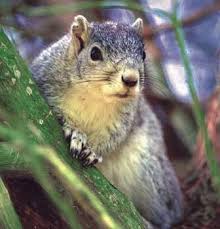
DFS vs. Grey Quirrel.  USFWS photo.According to the Chesapeake Bay Field Office of the U.S. Fish and Wildlife Service, the fox squirrel likes to live in old growth hardwood and pine forests, eating nuts or mature green pine cones.  During the spring, these squirrels add a little variety to their diets in the form of buds, flowers, fungi, seeds, and even insects.  Delmarva fox squirrels prefer to live in dens in hollowed-out trees, but will build nests in the branches of trees, much like the more familiar gray squirrel (Sciurus carolinensis).   Delmarva fox squirrels breed in the late winter and early spring; after a 44 day gestation, they give birth to a litter of up to 6 squirrels between February and April.

Here are 5 reasons to save the Delmarva Fox Squirrel:

1)  By preserving the forests on which these squirrels depend, we’re also helping many other, less charismatic but equally important, species

2)  The Delmarva fox squirrel population seems to be responding positively to reintroduction attempts (see MD DNR update) – there’s hope!

3)  Species such as the Delmarva fox squirrel, that move and eat seeds and nuts, help to maintain forest ecosystem health and reproduction

4)  Research indicates that these squirrels can survive in a landscape managed for agriculture and sustainable timber harvest

5)  Oh my gosh, how cute are these little guys?

Tuesday, July 10, 2012

5 Reasons to Love Hemlock Overlook

On the last day of school, my son’s fifth grade class visited Hemlock Overlook Regional Center (aka Camp Hemlock), a Northern Virginia Regional Park with a unique program.  The park is an outdoor education center that teaches about the ecosystems found inDSC_0027 northern VA, but it adds a little adventure into the experience.  Kids begin their visit with team building exercises (like trying to get an entire team of people across the imaginary swamp, as seen in the photo at right), or walking a team across a series of low wires.  They walk through the woods (something some of the kids rarely, if ever, get to do), learning not to purposely snap tree branches or squish bugs (again, new info for some of the kids).  They reach the “peanut-butter pit”, where they learn a little Civil War history and swing across a mud-pit.  Our group topped off the day with an exciting tight-rope walk and zip line that challenged even the most fearless in our group.
DSC_0053This park’s unique combination of challenges, sports, and nature was especially effective in reaching ALL the kids, not just those predisposed to interest in nature.  Even an accidental run-in with a wasp’s nest that got the two chaperones (yes, the greenmomster was one of them) and one unfortunate student couldn’t dampen our spirits!  What a great idea for environmental education!
So here are my five reasons to love Hemlock Overlook:
1)  Combining physical and mental learning for a memorable experience (and zip lines!)
2) A beautiful forest setting in busy northern Virginia (and zip lines!)
3) Very patient and experienced adult guides (and zip lines!)
4) Watching even the most timid kids swing over the mud pit (and zip lines!)
5)  Getting the kids away from the classroom and into nature for a day (did I mention the zip lines?)

Sunday, July 8, 2012

Join the Frack Attack Rally

On July 28, 2012, I’m going to be joining many other concerned citizens (as well as leaders from the Sierra Club and Natural Resources Defense Council) to march on Washington, D.C., at the Stop the Frack Attack Rally.  I hope that if you’re in the area you’ll also considerStop the Frack Attack lending your voice to this important cause.  Here’s some information about the rally and the underlying issue – you’ll want to do a little homework before deciding whether or not to participate.

What is “fracking"?  Hydraulic fracturing, or “fracking”, is a means of removing natural gas deposits from underground.  According to the BBC, fracking is “[t]he process of drilling down and creating tiny explosions to shatter and crack hard shale rocks to release the gas inside. Water, sand and chemicals are injected into the rock at high pressure which allows the gas to flow out to the head of the well. The process is carried out vertically or, more commonly, by drilling horizontally to the rock layer. The process can create new pathways to release gas or can be used to extend existing channels.”

Why is fracking controversial?   Fracking is controversial for a few reasons: 

  • First, after a well is fracked, the “flow back water”, or wastewater that returns to the surface is often contaminated with various chemicals, some are known carcinogens.  Treatment and storage of this water is of concern to people involved in water protection; they want to ensure proper treatment and no accidental releases to surface water. 
  • Second, there is some controversy regarding the cement casings that line the wells; safety standards must be set to prevent contamination of groundwater (see Wilderness Society for more information regarding this practice on public lands). 
  • Finally, many citizens are concerned about the lack of regulatory oversight of hydraulic fracturing.  The Energy Policy Act of 2005 (Pub.L 109-58) includes a loophole, often called the Haliburton loophole (section 322 of the act), which removes EPA’s oversight under the Safe Drinking Water Act of this industry’s underground reinjection of water used in hydraulic fracturing.   As requested by Congress, U.S. EPA is currently studying the effects of fracking on drinking water resources (the report is due in late 2012).  Other federal environmental laws that include some exemptions for the oil and gas industry (most were passed long before 2012), as outlined by the Environmental Working Group, include the Clean Air Act, the Comprehensive Environmental Response, Compensation, and Liability Act (CERCLA), the National Environmental Policy Act (NEPA), and the Resource Conservation and Recovery Act (RCRA).

If you have a little time, be sure to watch the Academy award nominated documentary on this topic, Gasland (I found it on Netflix).  The information comes quickly, and some of it is controversial, but the movie will give you a good overview of one side of the issue.  After you’ve viewed the documentary, be sure to read America’s Natural Gas Alliance’s (ANGA) rebuttal to the film.  Then follow up with Fox’s rebuttal to ANGA’s response.   And if all this he-said/she-said is getting to you, read the New York Times groundtruthing article of the Gasland film.

My expertise is not in energy production, rather it’s in natural resource issues, but I’ve read enough about the issue to decide that it’s time to get involved.  Here’s why I’m going to the rally:  I believe the old adage about the uselessness of closing the barn door after the horse is gone.  Hydraulic fracturing has the potential to do irreversible damage to our water supply.  I believe that the research regarding all the impacts of this industry should be done BEFORE drilling starts.  I believe that this industry should be subject to ALL of our environmental laws and regulations – those laws and regulations were put in place to protect the public.  And finally, I believe the U.S. should be looking for new, innovative, and clean energy sources.

Anyone planning to join me at the rally?

Friday, July 6, 2012

A Block Island Endangered Species

Since I just returned from a fun-filled vacation to MA and Block Island, RI, this week’s endangered species is the American Burying Beetle (Nicrophorus americanus) (photo from the SD Field Office of the FWS).  This nocturnal, orange and black beetle is the largest of the 32 species of burying beetles found in North America, usually 1 to 1.5 inches.  Talk about a unique lifestyle!  Here’s how the Center for Biological Diversity describes how the beetles mate and protect their young (activities that occur from April to September, but mostly in June and July, according to the NY Department of Environmental Conservation):  The American burying beetle is “uniquely dependant upon quail-size carrion weighing 100-200 grams [1, 15]. Males smell freshly dead mammals and birds (and occasionally even fish) within an hour of death and up to two miles away. Females arrive shortly thereafter, attracted by male pheromones. A competition ensues and is typically won by the largest male and female. Lying on their backs, the winning couple inches into an excavated burial chamber. During this time, orange phoretic mites borne by the beetles leap to the carcass, cleaning it of fly eggs and microbes. The buried carcass is relieved of its feathers, feet, tail, ears and/or fur. Now known as a "brood ball," it is coated with oral and anal embalming secretions to retard fungal and bacterial growth. The beetles then mate and within 24 hours lay eggs in the soil near the carcass. White grubs emerge three or four days later and are carried to the carcass. The parents also defend the grubs from predators and feed them regurgitated food. The American burying beetle is one of the few non-colonial insects in the world to practice dual parenting. In approximately a week, the grubs leave the chamber and pupate into adults.”  So cool!

The American burying beetle used to be found from Nova Scotia, through the midwest, and down to Florida and Texas.   Unfortunately, the population has declined by 90% from its historical distribution.  Scientists hypothesize that species decline is due to habitat loss and fragmentation, leading to a decline of the beetle’s carrion source. 

So what does this have to do with Block Island, RI?  Well it turns out that Block Island is the home to the only population of American burying beetles east of the Mississippi river.  These beetles can be found at Block Island National Wildlife Refuge, along with other endangered species, such as the piping plover, and the largest gull colony in Rhode Island.  We didn’t see any of the beetles while we visited the island, but maybe we’ll see them next time!


[1] U.S. Fish and Wildlife Service. 1991. American burying beetle (Nicrophorus americanus) recovery plan. Newton Corner, MA.

[15] Stevens, J. 2005. Conservation of the American burying beetle. CommuniQue, September, 2005:9-10.

Tuesday, July 3, 2012

Meat Free Friday–Flag Cake

Meat Free Friday is coming a couple days early this week, just in case you’d like to make this flag cake for July 4th (the recipe is adapted from one found in the Kraft Kitchens cookbook).  Quick note:  this recipe is not 100% vegetarian, since it uses Jello.

DSC_0024
Ingredients
1 qt strawberries (3 cups cut in half, 1 cup sliced)
1 1/2 cups boiling water
1 6 oz. package and 1 3 oz. package of red flavor Jello (strawberry, cherry, etc)
ice cubes
1 cup cold water
1 pound cake, cut into 10 slices
1 1/3 cup blueberries
whipped cream (you can use homemade or frozen)


Instructions
1)  Stir the boiling water into Jello in a large bowl for at least two minutes, until completely dissolved.  Add enough ice cubes to cold water to measure 2 cups.  Add this cold water to the Jello and stir until ice is melted.  Refrigerate until slightly thickened (about 5 minutes, until the liquid is the consistency of egg whites)
2)  Line the bottom of a 13x9 inch pan with cake slices.  Add sliced strawberries and 1 cup of the blueberries to the thickened Jello and stir gently.  Spoon over the cake slices.
3)  Refrigerate for 4 hours or until firm.  Spread the whipped cream over the Jello/cake mixture.  Arrange the strawberry halves like stripes on the flag, and the blueberries like stars.  Let the kids help – it doesn’t have to be perfect!

Happy 4th of July!

Sunday, July 1, 2012

Book Review–Unbowed by Wangari Maathai

I just got back from a vacation up to New England (it was great!), and my “vacation book” was Unbowed, by Wangari Maathai.  Not your usual light summer read, but definitely a book worth reading.  Wangari Maathai was born in Kenya in 1940, founded the Green BeltUnbowed: A Memoir Movement, and, in 2004, became the first African woman to receive the Nobel Peace Prize.  This memoir recounts her early childhood in Kenya during colonial times, her studies in the U.S., and her return to Kenya.  We learn how Maathai started and developed the Green Belt Movement, which was a network of rural women who grew and planted trees throughout Kenya (over 40 million trees according to the book).  The reader also follows her journey through the political landscape of Kenya as democracy developed.  Written in a very matter-of-fact tone, this memoir is not exactly an edge-of-your-seat thriller, but the reader’s  patience pays off.  As Maathai calmly describes the many ups and downs of her personal journey, the reader gets a detailed look at the sacrifices this remarkable woman made for the country and environment she loved.