Showing posts with label reintroduction. Show all posts

Monday, August 29, 2016

Mammal Monday -- the Przewalski's horse!

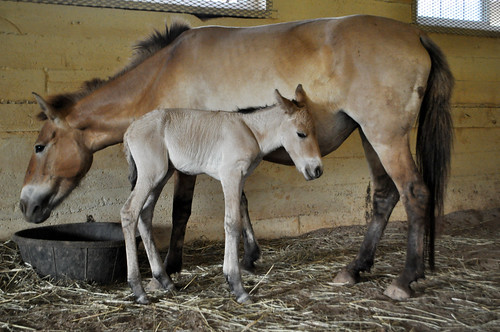
This week's mammal is the Przewalski’s Horse (pronounced “sheh-val-skee”). This horse is native to plains and grasslands of Mongolia, as well as other parts of Asia and eastern Europe, but I first saw one at the National Zoo’s Smithsonian Conservation Biology Institute in Front Royal, VA.  Although these horses are small (about 13 hands high and between 550 and 750 pounds), they’re impressive with tan fur on their bodies and a short, dark mane and tail.  They have evolved to survive the harsh winters in Mongolia, but in the 20th century the species had trouble surviving in the face of habitat loss, loss of water sources to domestic animals, and overhunting.  The Przewalski’s horse was declared extinct in the wild by the World Conservation Union in 1970.

Thanks to an active captive breeding program, Przewalski’s horses were reintroduced to the wild in 2008.  There are currently 1,500 horses in captivity worldwide, and approximately 400 horses in reintroduction sites in Mongolia, Kazahkstan, and China.  All of today’s current population of Przewalski’s horses come from 14 ancestors.  Thus, the gene pool for this horse is very narrow.  Scientists must very carefully coordinate breeding between the captive horses to try to maximize genetic diversity and make the population more able to withstand various stresses, such as disease.

So Przewalski’s horse is beautiful, but why should we care about its survival?  Because a species like this one tells us when we’re negatively impacting the ecosystem.  Humans are part of the natural world; we depend on natural resources for our survival.  But sometimes we take more than our share, and the ecosystem on which we depend begins to suffer.  Species like Przewalski’s horse tell us when our agricultural or hunting practices are unsustainable. 

And if you needed more reasons to protect the Przewalski’s horse, here are 5 Reasons Przewalski’s Horses are cooler than thoroughbreds:
  1. It is the only truly wild horse remaining in the world (it’s never been tamed for riding).
  2. I’ve never fallen off a Prezwalski’s horse (I’ve definitely fallen off a thoroughbred)
  3. Prezwalski’s horses can make it through winter in Mongolia without a horse blanket.
  4. The Mongolian name for these horses is “takhi,” which means “spirit.”   That’s way cooler than names like Chicken Lips or Buck Naked.
  5. Przewalski’s horses have 2 more chromosomes than domestic horses(66 vs. 64).
Oh, and did you know that horse vasectomies can be reversed?  Greenmomster’s always here for you with fun facts:


Thursday, May 22, 2014

TBT -- 5 reasons Przewalski’s horses are cooler than thoroughbreds

Przewalski’s horse filly

This week’s throwback Thursday post is in honor of the upcoming Belmont – will California Chrome earn the triple crown?  But wait, there’s an equally impressive creature out on the plains of Mongolia – the Przewalski’s horse!  (photo credit to National Zoo website)

The endangered species of the week is Przewalski’s Horse (pronounced “sheh-val-skee”). This horse is native to plains and grasslands of Mongolia, as well as other parts of Asia and eastern Europe, but I first saw one at the National Zoo’s Smithsonian Conservation Biology Institute in Front Royal, VA.  Although these horses are small (about 13 hands high and between 550 and 750 pounds), they’re impressive with tan fur on their bodies and a short, dark mane and tail.  They have evolved to survive the harsh winters in Mongolia, but in the 20th century the species had trouble surviving in the face of habitat loss, loss of water sources to domestic animals, and overhunting.  The Przewalski’s horse was declared extinct in the wild by the World Conservation Union in 1970.

Thanks to an active captive breeding program, Przewalski’s horses were reintroduced to the wild in 2008.  There are currently 1,500 horses in captivity worldwide, and approximately 400 horses in reintroduction sites in Mongolia, Kazahkstan, and China.  All of today’s current population of Przewalski’s horses come from 14 ancestors.  Thus, the gene pool for this horse is very narrow.  Scientists must very carefully coordinate breeding among the captive horses to try to maximize genetic diversity and make the population more able to withstand various stresses, such as disease.
So Przewalski’s horse is beautiful, but why should we care about its survival?  Because a species like this one tells us when we’re having too much of an impact on the ecosystem.  Humans are part of the natural world; we depend on natural resources for our survival.  But sometimes we take more than our share, and the ecosystem on which we depend begins to suffer.  Species like Przewalski’s horse tell us when our agricultural or hunting practices are unsustainable.
And if you needed more reasons to protect the Przewalski’s horse, here are 5 Reasons Przewalski’s Horses are cooler than thoroughbreds:

  1. It is the only truly wild horse remaining in the world (it’s never been tamed for riding).
  2. I’ve never fallen off a Prezwalski’s horse (I’ve definitely fallen off a thoroughbred)
  3. Prezwalski’s horses can make it through winter in Mongolia without a horse blanket.
  4. The Mongolian name for these horses is “takhi,” which means “spirit.”   That’s way cooler than names like Chicken Lips or Buck Naked.
  5. Przewalski’s horses have 2 more chromosomes than domestic horses(66 vs. 64).

Oh, and did you know that horse vasectomies can be reversed?  Greenmomster’s always here for you with fun facts:
 

Be sure to “Like” greenmomster on Facebook!

Wednesday, July 11, 2012

5 Reasons to save the Delmarva Fox Squirrel

This week’s endangered species is the Delmarva Fox Squirrel (Sciurus niger cinereus)(photo from newsforsquirrels.blogspot.com).  For those folks not in the Chesapeake Bay watershed, “Delmarva” is the peninsula that runs along the eastern shore of the Chesapeake Bay;  the Delmarva fox squirrel was historically found all along the Delmarva peninsula.  According to the species recovery plan, it’s now down to just 10% of its historical population (it was listed as federally endangered in 1967).  It is currently found in eight counties on the Eastern Shore of Maryland (all but Cecil) and Sussex County, Delaware and Accomack County, Virginia (from U.S. FWS Species Profile).  What’s causing the decline of this species?  I know I’m sounding like a broken record in these endangered species posts, but once again, the main culprit seems to be habitat fragmentation and loss. 

DFS vs. Grey Quirrel.  USFWS photo.According to the Chesapeake Bay Field Office of the U.S. Fish and Wildlife Service, the fox squirrel likes to live in old growth hardwood and pine forests, eating nuts or mature green pine cones.  During the spring, these squirrels add a little variety to their diets in the form of buds, flowers, fungi, seeds, and even insects.  Delmarva fox squirrels prefer to live in dens in hollowed-out trees, but will build nests in the branches of trees, much like the more familiar gray squirrel (Sciurus carolinensis).   Delmarva fox squirrels breed in the late winter and early spring; after a 44 day gestation, they give birth to a litter of up to 6 squirrels between February and April.

Here are 5 reasons to save the Delmarva Fox Squirrel:

1)  By preserving the forests on which these squirrels depend, we’re also helping many other, less charismatic but equally important, species

2)  The Delmarva fox squirrel population seems to be responding positively to reintroduction attempts (see MD DNR update) – there’s hope!

3)  Species such as the Delmarva fox squirrel, that move and eat seeds and nuts, help to maintain forest ecosystem health and reproduction

4)  Research indicates that these squirrels can survive in a landscape managed for agriculture and sustainable timber harvest

5)  Oh my gosh, how cute are these little guys?

Monday, April 16, 2012

5 Reasons that Przewalski’s Horses are cooler than thoroughbreds


The endangered species of the week is Przewalski’s Horse (pronounced “sheh-val-skee”). This horse is native to plains and grasslands of Mongolia, as well as other parts of Asia and eastern Europe, but I first saw one at the National Zoo’s Smithsonian Conservation Biology Institute in Front Royal, VA.  Although these horses are small (about 13 hands high and between 550 and 750 pounds), they’re impressive with tan fur on their bodies and a short, dark mane and tail.  They have evolved to survive the harsh winters in Mongolia, but in the 20th century the species had trouble surviving in the face of habitat loss, loss of water sources to domestic animals, and overhunting.  The Przewalski’s horse was declared extinct in the wild by the World Conservation Union in 1970.


Thanks to an active captive breeding program, Przewalski’s horses were reintroduced to the wild in 2008.  There are currently 1,500 horses in captivity worldwide, and approximately 400 horses in reintroduction sites in Mongolia, Kazahkstan, and China.  All of today’s current population of Przewalski’s horses come from 14 ancestors.  Thus, the gene pool for this horse is very narrow.  Scientists must very carefully coordinate breeding among the captive horses to try to maximize genetic diversity and make the population more able to withstand various stresses, such as disease.

So Przewalski’s horse is beautiful, but why should we care about its survival?  Because a species like this one tells us when we’re having too much of an impact on the ecosystem.  Humans are part of the natural world; we depend on natural resources for our survival.  But sometimes we take more than our share, and the ecosystem on which we depend begins to suffer.  Species like Przewalski’s horse tell us when our agricultural or hunting practices are unsustainable. 

And if you needed more reasons to protect the Przewalski’s horse, here are 5 Reasons Przewalski’s Horses are cooler than thoroughbreds:
  1. It is the only truly wild horse remaining in the world (it’s never been tamed for riding).
  2. I’ve never fallen off a Prezwalski’s horse.
  3. Prezwalski’s horses can make it through winter in Mongolia without a horse blanket.
  4. The Mongolian name for these horses is “takhi,” which means “spirit.”   That’s way cooler than names like Chicken Lips or Buck Naked.
  5. Przewalski’s horses have 2 more chromosomes than domestic horses (66 vs. 64).
Check out a video of this beautiful horse!