Showing posts with label agriculture. Show all posts

Sunday, February 14, 2016

Urban farming


[IMG_20130528_185252_561%255B3%255D.jpg]


Readers of Greenmomster know that our food choices have direct effects on the environment, as well as farm workers.  When we decide to eat less meat, the result is a smaller carbon footprint.  When we eat organic food, we decrease the pesticides used in food production (less exposure for the environment and farm workers), but we also increase the amount of land needed to produce food (decreased wildlife habitat) -- a trade-off that each consumer should consider.

Many of us also enjoy growing some of our own food!  Could the "backyard farmer" movement solve some of our food production problems?  Could we reduce use of fertilizer and water, while producing all the food that's locally needed?  According to a new study from the University of Washington published in the journal Urban Forestry and Urban Greening (reported by Sarah DeWeerdt of Conservation, 1/26/2016), while farming within city limits can produce substantial amounts of food, odds are good that we still need farmlands and lots of them.  Be sure to read the summary of the study.

What's the take-home lesson?  A few important points surface as we look at these results:

  1. Greening our cities is an important goal when it comes to decreasing energy costs and cleaning water
  2. Farmland preservation is also necessary to sustain an ever-increasing human population
  3. Food waste should be kept to a minimum in order to reduce food production environmental impacts.  Check out the Think.Eat.Save website for more info on reducing food waste.

Monday, July 6, 2015

How much water does your quarter-pounder need?

Be sure to “like” greenmomster on Facebook!

So you take short showers and you just bought a high-efficiency washer – good for you!  These are important steps in water conservation.  But there’s an even bigger water user in your life – your diet!

CameraAwesomePhoto (46)

We’ve posted several times about the environmental advantages of “eating low on the food chain.”  Now you can add conserving water to the list of good things that come from eating less meat.  According to When the Rivers Run Dry by Fred Pearce,

“Get your head around a few of these numbers, if you can.  They are mind-boggling.  It takes between 250 and 650 gallons of water to grow a pound of rice.  That is more water than many households use in a week.  For just a bag of rice.  Keep going.  It takes 130 gallons to grow a pound of wheat and 65 gallons for a pound of potatoes.  And when you start feeding grain to livestock for animal products such as meat and milk, the numbers become yet more startling.  It takes 3000 gallons to grow the feed for enough cow to make a quarter-pound hamburger, and between 500 and 1000 gallons for that cow to fill its udders with a quart of milk.  Cheese?  That takes about 650 gallons for a pound of cheddar or brie or camembert.”

So what’s the take-home?

  1. Eat low on the food chain to reduce water use
  2. Avoid wasting food.  According to the World Food Day website:
      • “In the USA, 30-40% of the food supply is wasted, equaling more than 20 pounds of food per person per month”
      • “In the USA, organic waste is the second highest component of landfills, which are the largest source of methane emissions”
      • “Every year, consumers in industrialized countries waste almost as much food as the entire net food production of sub-Saharan Africa (222 million vs. 230 million tons)”

Here are some ideas from World Food Day:

Think. Be a smart shopper and think about what you are buying and when it will be eaten. Wasting food is often a subconscious act – become aware of how much food you throw away. Plan meals and use shopping lists. Bring your leftovers home from restaurants in reusable containers.

Eat. Become a more mindful eater.  Eyes bigger than your stomach? Request smaller portions and become a leftovers guru.

Save. Save your food, save your money and save the environment. Donate to food banks and become a conscious consumer.

If you want to read more about the Think.Eat.Save food waste campaign, follow this link and get involved!

Sources:

Pearce, F. 2006.  When the Rivers Run Dry.  Boston, MA:  Beacon Press.  324 pp.

World Food Day – October 16.  Food Waste:  The Facts.  nd.  5 July 2015.  <http://www.worldfooddayusa.org/food_waste_the_facts>

Monday, December 1, 2014

I’m dreaming of a green Christmas!

2012Christmas22For all things green, be sure to "Like" greenmomster on Facebook!

It’s the first day of December, and once again we’re dreaming of a white Christmas (and we might get it on the East Coast tomorrow!), but what about a green Christmas?  Two years ago, greenmomster started posting some ideas for making your Christmas celebrations a little more eco-friendly.  Here are some old and new ideas for greening up the holiday!
noahbday11)  The wrapping!  Making Christmas gifts festive and fun to unwrap is part of the fun of giving the gifts.  Even the Grinch knew that taking the wrappings might put a damper on things as he left Who-ville:  “he packed up his sled, packed it up with their presents!  The ribbons!  The wrappings! The tags! And the tinsel!  The trimmings!  The trappings!” (XMAS FUN 2012).  But then again, according to Earth911, “wrapping paper and shopping bags alone account for about 4 million tons of trash annually in the U.S.”  None of us wants to be a Grinch, so how can we green up the wrappings?

  • If you want to wrap gifts in wrapping paper, why not try recycled paper?  And follow your mom and grandma’s lead – reuse that wrapping paper!
  • You can always wrap gifts in tissue paper (I use the tissue paper that’s stuck into dry cleaned clothes), fabric, or even the comics.
  • Reuseable gift bags can be used year after year (I have some bags that have been through at least 5 Christmases).
DSC_00012)  The tree!  OK, it’s the age-old debate – should we use a fresh tree?  artificial?  tree in a pot to be planted later?  A few thoughts, then you make your own decision:
  • Artificial trees – Here’s a fun fact from Earth911, “a U.S.-based toilet bowl brush manufacturer, the Addis Brush Company, created an artificial tree from brush bristles in the 1930s, acting as the prototype for modern artificial trees.”  I’ll remember that tidbit, as I relax next to my beautiful fake tree that I enjoy year after year.  Here’s the big con to artificial trees – most are made of non-recyclable, non-biodegradable metal and PVC.  Thus, when you throw them away, they’ll sit in the landfill for many generations to come.  Since my family keeps their artificial trees for decades (my mother has had her artificial tree for nearly 50 years), I’m not losing sleep over this con.  A more troublesome issue with artificial trees --  most are produced overseas and must be shipped to the U.S. – think fossil fuels and pollution in production and shipping  (Earth911 2012).  If you’ve decided on a fake tree,GoodHousekeeping has some recommendations regarding brands to try. 
  • Real trees – Most experts agree that this is the more eco-friendly option.  Over 30 million Christmas trees are sold in the U.S. each year, and 93% of those trees are recycled into mulch (Earth911 2012).  Additionally, Earth911 (2012) reports that a single farmed tree absorbs more than 1 ton of CO2 in its lifetime!  The cons?  Since Christmas trees are an agricultural product, we can expect application of pesticides, fertilizers, and herbicides, unless they’re grown organically.  Additionally, if you don’t live in an area where conifers grow naturally, add the cost of tree transport into your eco-footprint calculation (Earth911 2012).  If you do get a real tree, just say no to the plastic mesh wrapping.
  • Real LIVE trees – The most eco-friendly option.  Buy a live, potted tree, which you can keep in your house for about 1 – 1 1/2 weeks and then plant outdoors after the holidays.
3) The cards!  I come from a proud line of Christmas card senders and Christmas letter writers.  So how can we green up this annual tradition?
  • Send cards and letters online.  Friends and family can read about your adventures in the past year, and then save, print, or delete!
  • Try one of the eco-friendly card companies, using soy inks and recycled paper.  One of my favorites is Minted!
  • Send cards that support a green organization, such as the cards made by the National Wildlife Association or World Wildlife Fund.
DSC_00744)  The gifts!  There are actually fun green gifts that don’t lead to forced smiles and insincere “thank yous!” 
  • For the animal lovers in your family!  Through many organizations, you can symbolically “adopt” an animal, and receive a plush toy, certificate of adoption, and a poster or photograph.  Young children get a toy and wildlife organizations get badly needed financial support.  Some of the programs I’ve enjoyed in the past include theNational Zoo’s “Adopt a Species”, National Wildlife Federation’s Adoption CenterAdopt a Lemur from Duke U., and World Wildlife Fund’s Species Adoptions
  • Do you have a bike?  By giving bikes to not just the kids, but also the adults in the family, you’ll be encouraging the option of green transportation for local trips (plus you might lose a few of those Christmas cookie pounds!)
  • How about a new set of non-teflon coated cookware?  Have you been wanting to upgrade your cooking utensils?  By trading up for pots and pans that AREN’T coated in teflon, you’ll be reducing your family’s exposure to many harmful chemicals.
  • Got an avid gardener in the family, or do you want to become one?  Christmas is the perfect time to set someone up for a successful butterfly or vegetable garden in 2013 – garden tools, seeds, composting equipment, even rainbarrels are gifts that your family can enjoy throughout the year.  Birdfeeders and bird baths are a nice addition to any garden.  If you really want to go all out, how about beekeeping equipment?
  • Lifelong learning!  Gift certificates for classes are a waste-free gift that can be enjoyed throughout the year.  Be it cooking, archery, knitting, photography, or architecture classes – you know they’ll love it! 
  • How about a gift that lets the receiver enjoy the great outdoors?  Camping equipment was my gift at my last birthday!  Not into camping?  Think “roughing it” is a black and white TV?  Then how about binoculars or a field guide for an aspiring bird or butterfly watcher, or a camera for the budding nature photographer?
  • How about non-toxic soaps and shampoos from eco-friendly companies?  Many manufacturers now make these products, but some of my favorites are The Body Shop, Aveda, and the Parsonage.
  • Got someone in your family that enjoys camping or cabins?  Virginia State Parks offer gift certificates that can be used for camping, cabins, parking, and picnic shelter rentals.  Don’t live near VA?  You can always give an annual pass for national parks and federal recreational lands.  Need trip inspiration?  Check out this post on Bryce National Park.
Want more great ideas on how to green your holidays?  Check outEarthEasy’s tips for green gift giving, wrapping, and lighting.
From the greenmomster’s house to yours, we wish you a very merry and GREEN holiday season!2012Christmas37
Sources:
Earth911.  2012.  Facts About Recycling Wrapping Paper.  Accessed 11/29/12.
http://earth911.com/recycling/paper/wrapping-paper/facts-about-recycling-wrapping-paper/
EarthEasty.  2012.  How to have a ‘green’ Christmas.  Accessed 11/29/12.http://eartheasy.com/give_sustainchristmas.htm
GoodHousekeeping.  2012.  Getting an Artificial Christmas Tree!  Choose This Type.  You’ll save resources and reduce risk of toxins.  Accessed 11/29/12.  http://www.thedailygreen.com/going-green/tips/artificial-christmas-trees-buy-american
XMAS FUN.  2012.  How the Grinch Stole Christmas by Dr. Seuss.  Accessed 11/29/12.http://xmasfun.com/stories/Grinch/Text.asp

Sunday, November 10, 2013

Farming for the Future

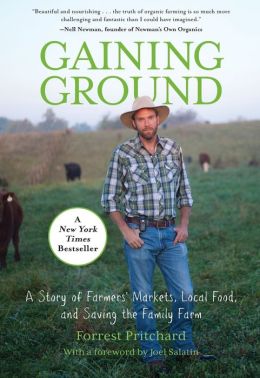
Gaining Ground: A Story of Farmers' Markets, Local Food, and Saving the Family FarmWant to keep up on all the latest green news?  Be sure to "Like" greenmomster on facebook!

Many greenmomsters are trying to change their families’ eating habits by buying more organic and locally-grown fruit, vegetables, and meats, but what goes into producing such foods?  In his book, Gaining Ground, Forrest Pritchard tells us about his life farming in Virginia.  Rather than following his classmates to more lucrative jobs in large cities, Mr. Pritchard decided to return to his family’s farm after graduating from William and Mary (Alma Mater of a Nation!).  Over the course of several years, Mr. Pritchard learns to farm using sustainable practices and selling his food locally.  This entertaining book takes the reader through the highs and lows of his adventure.  Additionally, the author answers important questions:
  • Why is organically grown food beneficial to the environment and to our health?
  • Why is food sold at farmers’ markets slightly more expensive than food sold at grocery stores?
  • What is meant by  “industrially" raised meat? How does it differ from “pasture raised”?
  • How can things go wrong with a rampaging hog?
  • Why should I try to shop for local food products?  Do local farmers really need my support?
  • How does agriculture affect the local environment – in this case, the Chesapeake Bay watershed?
  • Can I influence which products my local farmers choose to grow and produce?
Although I’m not a meat-eater (I’ll more likely buy his wife’s locally made pasta), I highly recommend this enjoyable read – you’ll be hooked after the story of the stingy old lady buying firewood.  You’ll learn a lot about food production and your purchasing choices, and as an added bonus, you’ll understand why William and Mary produces some of the best scholars in the U.S. (Alma Mater of a Nation!)

Saturday, December 1, 2012

I’m dreaming of a green Christmas….

Yes, we’re all dreaming of a white Christmas (I’m guessing it’s not going to happen here in northern VA), but what about a green Christmas?  This season includes a few decisions to make our Christmas celebrations a little more eco-friendly:

noahbday11)  The wrapping!  Making Christmas gifts festive and fun to unwrap is part of the fun of giving the gifts.  Even the Grinch knew that taking the wrappings might put a damper on things as he left Who-ville:  “he packed up his sled, packed it up with their presents!  The ribbons!  The wrappings! The tags! And the tinsel!  The trimmings!  The trappings!” (XMAS FUN 2012).  But then again, according to Earth911, “wrapping paper and shopping bags alone account for about 4 million tons of trash annually in the U.S.”  None of us wants to be a Grinch, so how can we green up the wrappings?

  • If you want to wrap gifts in wrapping paper, why not try recycled paper?  And follow your mom and grandma’s lead – reuse that wrapping paper!
  • You can always wrap gifts in tissue paper (I use the tissue paper that’s stuck into dry cleaned clothes), fabric, or even the comics.
  • Reuseable gift bags can be used year after year (I have some bags that have been through at least 5 Christmases).

DSC_00012)  The tree!  OK, it’s the age-old debate – should we use a fresh tree?  artificial?  tree in a pot to be planted later?  A few thoughts, then you make your own decision:

  • Artificial trees – Here’s a fun fact from Earth911, “a U.S.-based toilet bowl brush manufacturer, the Addis Brush Company, created an artificial tree from brush bristles in the 1930s, acting as the prototype for modern artificial trees.”  I’ll remember that tidbit, as I relax next to my beautiful fake tree that I enjoy year after year.  Here’s the big con to artificial trees – most are made of non-recyclable, non-biodegradable metal and PVC.  Thus, when you throw them away, they’ll sit in the landfill for many generations to come.  Since my family keeps their artificial trees for decades (my mother has had her artificial tree for nearly 50 years), I’m not losing sleep over this con.  A more troublesome issue with artificial trees --  most are produced overseas and must be shipped to the U.S. – think fossil fuels and pollution in production and shipping  (Earth911 2012).  If you’ve decided on a fake tree, GoodHousekeeping has some recommendations regarding brands to try. 
  • Real trees – Most experts agree that this is the more eco-friendly option.  Over 30 million Christmas trees are sold in the U.S. each year, and 93% of those trees are recycled into mulch (Earth911 2012).  Additionally, Earth911 (2012) reports that a single farmed tree absorbs more than 1 ton of CO2 in its lifetime!  The cons?  Since Christmas trees are an agricultural product, we can expect application of pesticides, fertilizers, and herbicides, unless they’re grown organically.  Additionally, if you don’t live in an area where conifers grow naturally, add the cost of tree transport into your eco-footprint calculation (Earth911 2012).  If you do get a real tree, just say no to the plastic mesh wrapping.
  • Real LIVE trees – The most eco-friendly option.  Buy a live, potted tree, which you can keep in your house for about 1 – 1 1/2 weeks and then plant outdoors after the holidays.

3) The cards!  I come from a proud line of Christmas card senders and Christmas letter writers.  So how can we green up this annual tradition?

  • Send cards and letters online.  Friends and family can read about your adventures in the past year, and then save, print, or delete!
  • Try one of the eco-friendly card companies, using soy inks and recycled paper.
  • Send cards that support a green organization, such as the cards made by the National Wildlife Association or World Wildlife Fund

DSC_00744)  The gifts!  There are actually fun green gifts that don’t lead to forced smiles and insincere thank yous! 

  • For the animal lovers in your family!  Through many organizations, you can symbolically “adopt” an animal, and receive a plush toy, certificate of adoption, and a poster or photograph.  Young children get a toy and wildlife organizations get badly needed financial support.  Some of the programs I’ve enjoyed in the past include the National Zoo’s “Adopt a Species”, National Wildlife Federation’s Adoption Center,  and World Wildlife Fund’s Species Adoptions
  • Do you have a bike?  By giving bikes to not just the kids, but also the adults in the family, you’ll be encouraging the option of green transportation for local trips (plus you might lose a few of those Christmas cookie pounds!)
  • How about a new set of non-teflon coated cookware?  Have you been wanting to upgrade your cooking utensils?  By trading up for pots and pans that AREN’T coated in teflon, you’ll be reducing your family’s exposure to many harmful chemicals.
  • Got an avid gardener in the family, or do you want to become one?  Christmas is the perfect time to set someone up for a successful butterfly or vegetable garden in 2013 – garden tools, seeds, composting equipment, even rainbarrels are gifts that your family can enjoy throughout the year.  Birdfeeders and bird baths are a nice addition to any garden.  If you really want to go all out, how about beekeeping equipment?
  • Lifelong learning!  Gift certificates for classes are a waste-free gift that can be enjoyed throughout the year.  Be it cooking, archery, knitting, photography, or architecture classes – you know they’ll love it! 
  • How about a gift that lets the receiver enjoy the great outdoors?  Camping equipment was my gift at my last birthday!  Not into camping?  Think “roughing it” is a black and white TV?  Then how about binoculars or a field guide for an aspiring bird or butterfly watcher, or a camera for the budding nature photographer? 

Want more great ideas on how to green your holidays?  Check out EarthEasy’s tips for green gift giving, wrapping, and lighting.

From the greenmomster’s house to yours, we wish you a very merry and GREEN holiday season!


Sources:

Earth911.  2012.  Facts About Recycling Wrapping Paper.  Accessed 11/29/12.  http://earth911.com/recycling/paper/wrapping-paper/facts-about-recycling-wrapping-paper/

EarthEasty.  2012.  How to have a ‘green’ Christmas.  Accessed 11/29/12.  http://eartheasy.com/give_sustainchristmas.htm

GoodHousekeeping.  2012.  Getting an Artificial Christmas Tree!  Choose This Type.  You’ll save resources and reduce risk of toxins.  Accessed 11/29/12.  http://www.thedailygreen.com/going-green/tips/artificial-christmas-trees-buy-american

XMAS FUN.  2012.  How the Grinch Stole Christmas by Dr. Seuss.  Accessed 11/29/12.  http://xmasfun.com/stories/Grinch/Text.asp

Wednesday, February 15, 2012

Cotton – the fabric of our lives?

Today, I’m thinking about my favorite article of clothing – the t-shirt.  What other piece of clothing can you wear to bed, wear to work out, make into a dress, and wear to work (if you work at home like this green momster)?  I love t-shirts -- big, baggy t-shirts.  I’ve always loved t-shirts, from the t-shirt I had in 8th grade with a St. Bernard dog on it that said, “don’t eat yellow snow!”, to my honeymoon souvenir t-shirt covered in lizards that says “all gecked out and nowhere to go,” to my current favorite 4-H fair t-shirt designed by my son.  Yes, I’ve always been a snappy dresser.

So I’m thinking about t-shirts, which gets me thinking about cotton.  The biggest producers of cotton in the world are the U.S., China, Pakistan, and Australia.  Texas is the biggest state producer of cotton and was hard hit by last year’s drought.  Cotton requires a relatively long, hot growing season and fertile soil with lots of nitrogen.  The other thing that cotton needs is a way to fight off insect predators, and that’s where we get into some environmental trouble.  Up to 15% of a cotton crop can be lost to insects.  In the past, the response of cotton growers has been pesticides and fertilizers. 

According to Mother Earth News and the Organic Trade Association, 25% of the world’s insecticide use goes to cotton crops alone.  Three of the most acutely hazardous insecticides, according to the World Health Organization, are 3 of the top ten insecticides used for cotton production.  These pesticides can make their way into soil and water supplies, affecting the health of workers in the cotton fields and anyone else who lives in the area.  Pesticide exposure can lead to birth defects, reproductive disorders, nervous disorders, and weaker immune systems.  The arrival of Bt cotton, or cotton with the insecticide inside the plant, has added to the impact of this crop on native, beneficial insects.  Additionally, excess use of nitrogen fertilizer to supplement the soil leads to runoff into local water sources. The result of this runoff can be eutrophication and dead zones where there isn’t enough oxygen for fish and other aquatic life to survive (check out how this happens in the Chesapeake Bay).

To make 1 cotton t-shirt, it takes roughly 1/3 of a pound of insecticides and fertilizers.  Wow, read that again.  So what’s a consumer to do?   Organic cotton is one option.  It’s more expensive than regular cotton, because it costs more to make sure growing cotton doesn’t have so many environmental “side-effects.”  One disadvantage of organic cotton is the increased area needed for cultivation (some of the crop will be lost to insects).  But the advantages greatly outweigh the disadvantages – less pesticide exposure, cleaner water, and better working conditions for farm laborers.  And if you’re into “buying American,” the U.S. is the 6th largest producer of organic cotton.  For more information on organic cotton (how it’s grown, the producers, etc.), check out Organic Cotton.

Coming down the pipe are some selective breeding programs to develop naturally insect-resistant cotton crops, as well as colored cotton, which reduce the need for pesticides and dyes.  Sally Fox is the innovator of this new type of organically grown cotton.

Sally Fox–organic, colored cotton
Let’s say organic cotton isn’t an option for you.  Another way to lessen the impact of the cotton you buy, is by buying locally grown and produced cotton product.  Often, cotton grown in the U.S. is shipped overseas to be made into t-shirts and jeans.  The fossil fuels used to ship cotton around the world for production adds greenhouse gases to the atmosphere.  Are there any locally produced options (organic or conventionally grown)?  In North Carolina, there’s a cotton production system that ships less than 700 miles from field to t-shirt.  Check out the information on Cotton of the Carolinas.

Cotton of the Carolinas
Living on the west coast of the U.S.?  Check out what’s going on with the Sustainable Cotton Project.

So now you’re saying, “But it’s too expensive and difficult to buy organic or locally produced t-shirts every time my child needs new clothes.”  Fair enough.  Then consider every frugal green momster’s favorite option – check out second-hand stores for kids’ clothes, so that those cotton products get one more chance and new clothes don’t have to be produced.

So here’s my plan:  I’m going to hold on to my old t-shirts, jeans, and cotton blankets, but when it’s time to replace them, I’m going to search out the organic or locally grown option.  Will I be able to afford to go organic every time?  Probably not.  But every little bit helps (be the hummingbird!)  I already bought an organic cotton blanket from Pottery Barn, and I was very pleased with the product.  Patagonia, a major sportswear producer, has pledged to only use organic cotton in its products.

Oh, and if you’re wondering how to work your old jeans into the “reduce, reuse, recycle” ethic and you thought Daisy Dukes were your only option, check this out:  http://video.nationalgeographic.com/video/kids/green-kids/cotton-making-jeans-kids/ – recycled cotton insulation!

Anybody else have ideas for low-impact cotton?