Friday, May 30, 2014

Italian soul food!

It’s almost summer, and I, for one, am looking forward to tasty food at summer festivals.  One of my favorites is italian sausage and pepper sandwiches.  How can a vegetarian greenmomster have all the tastiness and none of the meat?  Here’s the vegetarian version; we call it “Italian soul food” at our20140528182354 house!

Ingredients:


1 package Smart Sausages Italian Syle
1 green pepper
1 red pepper
1 onion
8 tblsp olive oil
hot dog buns


Instructions:
1)  Slice peppers and onions into long, thin strips.
2)  Put 4 tblsp olive oil into each of two frying pans and heat.  Fry italian sausage in one pan and peppers and onion in the other (until the pepper and onion are very soft)
3)  Place sausage into hot dog bun and top with peppers and onions.  Enjoy!

Thursday, May 29, 2014

TBT–an endangered species success story!

This week’s throwback Thursday post comes from Memorial Day 2012 – a success story!  Be sure to “Like” greenmomster on Facebook for more environmental success stories.

For Memorial Day, we’re going to take a look at an endangered species success story – the bald eagle (Haliaeetus leucocephalus)!  Who doesn’t love seeing our national symbol (since 1782) flying majestically through the skies?  I know that one of the high points ofour recent visit to Chincoteague NWR (photo from allaboutbirds.org) was seeing the beautiful bald eagle fly above us as we biked the island.  But views of bald eagles weren’t always so common.  According to National Geographic News, there were only 417 nesting pairs in 1963.   Many attempts were made to try to protect bald eagles, including  the 1940 Bald Eagle Protection Act and listing under the Endangered Species Act of 1973, but it was the banning of DDT that really helped the recovery of these birds. 

DDT was a commonly used insecticide in the 1950s and 1960s.  Insects had the DDT in their systems, and fish then ate the insects.  Eagles then ate the fish.  As we move up the food chain (insect to fish to eagle), more and more of the insecticide would accumulate in the tissues of each animal (ie.  an insect has a little insecticide; fish eat many insects, thus their tissues have more insecticide; eagles eat many fish).  This phenomenon is called “bioaccumulation”.  DDT caused the eggshells of eagles to soften, so young would not survive.  Thanks to the banning of all hunting of eagles and of all use of DDT, we can enjoy seeing our national bird today and everyday!

Bald eagle fun facts: 

  • The bald eagle is a large bird, weighing between 10 and 14 pounds. 
  • Bald eagles can live up to thirty years, reaching sexual maturity at around 5 years. 
  • Both males and females share the duty of incubating the eggs (about 35 days)
  • Bald eagles can fly at speeds up to 35 mph

Check out NWF’s eagle cam to get your daily eagle fix!
Broadcast live streaming video on Ustream

Friday, May 23, 2014

Turtles Rock!

Want to keep up on all the latest green news?  Be sure to "Like" greenmomster on Facebook!

In honor of World Turtle Day, I’m re-posting about my favorite animals – the loggerheads at Edisto Island SC!  Meat-free Friday resumes next week!


As I’ve mentioned in previous posts, one of the high points of my summer each year is visiting the beaches of South Carolina and watching the baby loggerhead turtles head for life in the ocean.  This year was no different!  It’s been a great year for loggerheads in SC; both Bull Island and the Edisto Beach State Park reported their second highest number of nests (last year was number 1).  One of the naturalists speculated that since the turtle protection project is in its 30th year, and it takes roughly 30 years for loggerhead turtles to reach sexual maturity, the program is just now beginning to show the product of all the hard work.  Turtle project managers hope that this is just the beginning of many more successful nesting years for these endangered turtles.
Loggerhead turtles are truly impressive creatures.  They start off small, but grow to a whopping 200-300 lbs!  IMG_20130815_190125_501  Following a harrowing run to the ocean, avoiding hungry seagulls, the baby turtles hitch a ride on an ocean current and make their way to the Sargasso Sea.  There they float in the sargassum until they grow large enough to continue their 30 year journey north through the Atlantic Ocean and then down to the Caribbean.  Only about 1 in 1000 eggs laid reaches sexual maturity!
Here’s a myth-buster!  Have you heard that sea turtles always return to the same beach to nest?  Well, recent DNA research is showing that this isn’t always the case.  One female turtle this year laid eggs in three states!
So what is this turtle protection program I keep mentioning?  Many naturalists, turtle researchers, and volunteers deserve credit for this successful program.  Tiny turtles hatch from the soft eggs IMG_20130815_184203_296, which the females lay in deep holes above the high tide line in the middle of the night.  Early each morning, researchers and volunteers head to the beach to mark the location of new nests and protect the nests with flags and fencing.  If staff believe that the nests are below the high tide line, they may decide to move the nest further toward the dunes to avoid flooding of the nest.  After the expected date of nest hatching, staff again spring into action.   This volunteer is digging up a nest which has already hatched, to see if there are any hatchlings alive but trapped in the nest (they didn’t make it out with the rest of the baby turtles).   IMG_20130815_184059_922  After digging up the hatched nests, volunteers and program staff log the number of eggs hatched and the number of unhatched eggs:  IMG_20130815_184641_381.  The nest in the previous picture had many unhatched eggs; staff hypothesized that the nest was laid below the high tide line.  After the volunteers find any turtles still trapped in the nest, they set the tiny creatures free to begin their ocean adventure.  turtle hatchling at sunset
Sea turtles have been on Earth for millions of years and are currently threatened by human activities including entrapment in fishing gear, boat strikes, and pollution which turtles can mistake for food.  You can help these incredible creatures and the programs designed to protect them:

  • Never litter on the beach.  Pick up any litter you see (cups, plastic bags, bottles) to protect turtles from accidental ingestion
  • Only buy shrimp from fleets that use Turtle Excluder Devices (TEDs) on their fishing gear (it’s a law for U.S. fleets)
  • You can adopt a turtle or adopt a nest – what a great way to help protect these magnificent creatures!

Thursday, May 22, 2014

TBT -- 5 reasons Przewalski’s horses are cooler than thoroughbreds

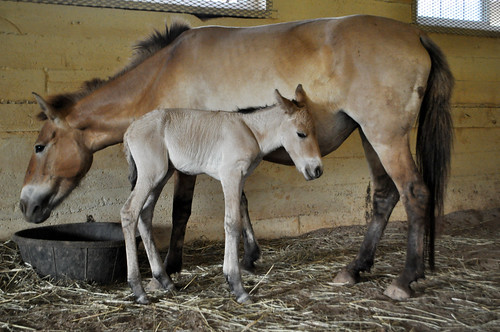
Przewalski’s horse filly

This week’s throwback Thursday post is in honor of the upcoming Belmont – will California Chrome earn the triple crown?  But wait, there’s an equally impressive creature out on the plains of Mongolia – the Przewalski’s horse!  (photo credit to National Zoo website)

The endangered species of the week is Przewalski’s Horse (pronounced “sheh-val-skee”). This horse is native to plains and grasslands of Mongolia, as well as other parts of Asia and eastern Europe, but I first saw one at the National Zoo’s Smithsonian Conservation Biology Institute in Front Royal, VA.  Although these horses are small (about 13 hands high and between 550 and 750 pounds), they’re impressive with tan fur on their bodies and a short, dark mane and tail.  They have evolved to survive the harsh winters in Mongolia, but in the 20th century the species had trouble surviving in the face of habitat loss, loss of water sources to domestic animals, and overhunting.  The Przewalski’s horse was declared extinct in the wild by the World Conservation Union in 1970.

Thanks to an active captive breeding program, Przewalski’s horses were reintroduced to the wild in 2008.  There are currently 1,500 horses in captivity worldwide, and approximately 400 horses in reintroduction sites in Mongolia, Kazahkstan, and China.  All of today’s current population of Przewalski’s horses come from 14 ancestors.  Thus, the gene pool for this horse is very narrow.  Scientists must very carefully coordinate breeding among the captive horses to try to maximize genetic diversity and make the population more able to withstand various stresses, such as disease.
So Przewalski’s horse is beautiful, but why should we care about its survival?  Because a species like this one tells us when we’re having too much of an impact on the ecosystem.  Humans are part of the natural world; we depend on natural resources for our survival.  But sometimes we take more than our share, and the ecosystem on which we depend begins to suffer.  Species like Przewalski’s horse tell us when our agricultural or hunting practices are unsustainable.
And if you needed more reasons to protect the Przewalski’s horse, here are 5 Reasons Przewalski’s Horses are cooler than thoroughbreds:

  1. It is the only truly wild horse remaining in the world (it’s never been tamed for riding).
  2. I’ve never fallen off a Prezwalski’s horse (I’ve definitely fallen off a thoroughbred)
  3. Prezwalski’s horses can make it through winter in Mongolia without a horse blanket.
  4. The Mongolian name for these horses is “takhi,” which means “spirit.”   That’s way cooler than names like Chicken Lips or Buck Naked.
  5. Przewalski’s horses have 2 more chromosomes than domestic horses(66 vs. 64).

Oh, and did you know that horse vasectomies can be reversed?  Greenmomster’s always here for you with fun facts:


Be sure to “Like” greenmomster on Facebook!

Sunday, May 18, 2014

What’s your environmental IQ?

skymeadows spring 2014 1Many of us think we know a lot about environmental issues, but how much do we really know?  Here’s a great quiz, posted by the City of Tulsa OK , that can give you an idea of your “environmental IQ”. 

Here’s an additional little quiz to help you figure out what’s in your backyard and become more aware of your local environment.  Unfortunately, I can’t provide the answers for every locale --if you don’t know the answers, I guess you know what you’ve got for homework!

  1. In which watershed do you live?  A watershed is a topographical area that drains to one body of water.  So where does your stormwater drain – what’s the name of your local creek?
  2. What’s the source of your drinking water?  (groundwater, surface water (which body of water?))
  3. What happens to your garbage when it leaves your house?  Does it go to a landfill, incinerator, etc?
  4. Name two bird species that live in your area year-round.winter cardinal
  5. Name two bird species that migrate in and out of your area every year.
  6. What’s the source of your electric power?  (coal, natural gas, nuclear, solar?)
  7. Where’s your local wastewater treatment plant? (usually, it’s pretty easy to Google this one!)

Want to try some “big picture” (rather than local) environmental quizzes?  Check out the ABC News Environmental IQ test and The Wall Street Journal.

Friday, May 16, 2014

Green Chili Stew

Billy Joel might be in a New York state of mind, and James Taylor has Carolina on his mind, but I’m thinking about dry New Mexico today (easily one of my favorite places) as flood warnings rage here in VA.  Here’s a recipe for green chili 69790002stew from Family Circle magazine that I’ve altered (rather significantly) to taste just the way I like it.  I hope it takes you to New Mexico in your mind! (and be sure to Like greenmomster on Facebook for your weekly recipes!)

Ingredients:

6 cups vegetable broth
1 jar tomatillo salsa (I like Frontera)
1 large green pepper, diced
1 large yellow onion, diced
1 tbsp olive oil
3 heaping tablespoons of minced garlic
2 tsp cumin
3, 4 oz. cans of hot diced green chilis (I like Hatch)
1 tsp salt
2 12 oz. packages of Quorn Chick’n Tenders
2 15.5 oz cans of butter beans, drained and rinsed (use 3 cans if you want really thick stew, rather than soup)
1/4 cup chopped fresh cilantro
sour cream, scallions


Instructions:
1) In a large pot, saute onion, green pepper, and garlic in olive oil to slightly soften the peppers -- don't let the onions become transparent.  Add veggie broth, salsa, cumin, chilis, and salt. Add in quorn nuggets and simmer on low heat for at least 1/2 hour.
2) Stir in beans and cilantro.
697900013) Garnish with sour cream and scallions, if desired.  Serve with Phil's corn bread

Thursday, May 15, 2014

TBT–We are the 10%

It’s allergy season, which means those of us with asthma are huffing and puffing.  Here’s the perfect Throwback Thursday post from a couple of years ago.  To see all the latest posts and more info, be sure to “like” greenmomster on Facebook.

It was about 2 am and there I sat, waiting, listening, and hoping that my son’s asthma medication would take effect quickly.  Our family has three of the approximately 34 million Americans with asthma.  That’s roughly 10% of the U.S. population, according to the American Lung Association.  Asthma is an iA mother helps her daughter with an asthma inhaler.nflammation of the airways, making it difficult to breathe.  Asthma has significant health and economic effects:  

  • the CDC National Center for Health Statistics estimates that asthma is the reason for approximately half a million hospitalizations per year
  • the Centers for Disease Control and Prevention estimate that medical expenses associated with asthma increased from $48.6 billion in 2002 to $50.1 billion in 2007.  About 2 in 5 (40%) uninsured people with asthma could not afford their prescription medicines and about 1 in 9 (11%) insured people with asthma could not afford their prescription medicines.
  • the CDC National Center for Health Statistics states that asthma accounts for about 10.1 missed work days per year
  • Females have a 23% higher occurrence of asthma than males (American Lung Association)
  • Between 2001 to 2003, the occurrence of asthma in the U.S. was highest in the Northeast region (CDC)
  • According to the American Lung Association, in 2006, asthma prevalence was 20.1% higher in African Americans than in whites
  • According to the CDC, from 2001-2003, asthma prevalence was higher in individuals living below the federal poverty level (10.3%) compared with those at or above the federal poverty level (6.4% to 7.9%)
And moms, take note:
  • The greatest rise in asthma rates was among black children(almost a 50% increase) from 2001 through 2009 (CDC Vital Signs, 5/11)
  • 185 children died of asthma attacks in 2007 (CDC Vital Signs, 5/11) and nearly 4 million children had asthma attacks last year (Akinbami LJ. The State of childhood asthma, United States, 1980–2005. Advance data from vital and health statistics; no 381, Hyattsville, MD: National Center for Health Statistics. 2006)
  • For children under 15, asthma is the 3rd leading cause of hospital stays (DeFrances CJ Cullen KA, Kozak LJ. National Hospital Discharge Survey: 2005 Annual Summary with Detailed Diagnosis and Procedure Data. National Center for Health Statistics. Vital Health Statistics 12 (165); 2007)
  • From 2001 to 2003, the CDC reports that the occurrence of asthma in children (8.5%) was higher than in adults (6.7%)

So what triggers asthma and asthma attacks?  First off, asthma is a family affair.  Children with parents who have asthma are more likely to have asthma themselves.  A predisposition for having asthma has been found to be passed down genetically.  Now, just because a person has a predisposition, that doesn’t mean they’ll actually get the disease.  But if they do, what might set off an asthma attack?  Allergies often lead to asthma (dust mites, molds, pollen, etc).  Virus and bacterial infections can lead to asthma symptoms (often, a person with asthma will begin to wheeze or cough if they get a cold).  Some people have exercise-induced asthma.  Others get asthma attacks due to certain foods or drugs.  But asthma can be triggered by something else. 

Asthma can be triggered by pollution.  Pollutants such as particulate matter, sulfur dioxide (SO2), and ozone (ground-level ozone, that is) have been shown to increase the occurrence of asthma attacks, particularly in children.  What types of activities produce these pollutants?  The small particles that might affect the lungs are produced from the chemical reaction of pollutants from power plants, industries, and automobiles.  Sulfur dioxide is most commonly produced from the burning of fossil fuels (coal and oil), as well as cement production.  Ozone isn’t usually emitted directly as a pollutant; it’s formed by the action of sunlight on NOx which comes from car exhausts, fuel combustion, and industrial processes.  Beginning to see a trend?  The pollutants that cause the most problems for asthmatics come from our cars and our power plants.   Limiting discharge of pollutants will protect children and other people affected by asthma.  Will it raise our fuel costs?  Possibly.  There’s some conflicting information as discussed by the Edison Electric Institute and the Congressional Research Service.  Full disclosure, my husband works for an energy company, so I’ve heard both sides of the argument.  But let’s look at it this way – someone has to pay.  Should we, the users of cars and power from fossil fuels, each pay a little more for a cleaner environment, or should we ask the payment to be made by the most vulnerable – our children, individuals living below the poverty level, the elderly?  My son’s asthma is controlled with medicine and attacks are infrequent, but others are not so lucky.


What can one person do?  Get educated about efforts to limit discharge of these pollutants to the environment.  Contact your legislators/local industries/power producers regarding this issue – let your opinion be known.